Smore logo
remove_red_eye 62
page background
Lake County Health Department

Talk today. Trust tomorrow.

Small Moments. Big Impact. June & July Edition

Talk today. Trust tomorrow. Small Moments. Big Impact. June & July Edition
Talk today. Trusttomorrow.Small Moments. Big Impact. June & July Edition

"Strengthening children and adolescents’ connection with their families, schools, peers, and other adults is an important protective factor that can reduce the effects of stressful life events and teach skills to overcome them."

- The CDC


Parents and families play a critical role, often being the first to help their children develop skills to recognize and manage emotions, establish and maintain positive relationships, and make responsible decisions.

The Family Check-up The Family Check-up

Good communication between parents and children is the foundation of strong family relationships.

Communication helps parents catch problems early, support positive behavior, and stay aware of what is happening in their children's lives.

Getting Started

  • Choose a moment when you can give your child your undivided attention, making the conversation meaningful and impactful.
  • Enter the discussion with a clear plan and organized thoughts to guide the conversation smoothly.
  • Maintain a calm and patient demeanor, ensuring a supportive and open dialogue.
  • Create a distraction-free environment by turning off phones and other devices, allowing for genuine connection.
  • Agree on a time frame for the conversation to keep it focused and respectful of each other’s time
User uploaded image
zoom_out_map

Some Key Communicating Skills

  • Show interest and concern without assigning blame; ask, “That sounds difficult. Were you confused?” instead of “How did you get into this situation?”
  • Promote problem-solving; say, “What do you think would have been a better way to handle that?” instead of “What did you think was going to happen when you don’t think?”
  • Listen and Observe: Youth are more likely to share issues with parents who listen without judgment.
  • Encouragement builds confidence, helps you promote cooperation, and then reduces conflict


What Doesn't Work

  • Sarcasm or negativity
  • Comparing a child to siblings or friends
  • Taking over if a child is slow to progress


Avoid

  • Addressing pressing issues.
  • Assigning blame or belittling the other person.
  • Assuming the other person's intentions.
  • Defending yourself; practice the art of letting go.
  • Rehashing past grievances.
  • Giving lectures

Steps to Problem solving

  • Encourage brainstorming by generating three ideas each, taking turns.
  • List the positives and negatives for each idea and combine them if needed.
  • Ensure everyone agrees on the chosen solution.
  • Follow up after trying the solution to assess its effectiveness; if it’s not working, revisit the ideas and brainstorm further if necessary. Clinical Application: Problem-solving is a practical skill in recovery and parenting. Practice it in session to help clients reduce power struggles and focus on repair, not control.

Additional Links & Resources Additional Links & Resources

Why Small Conversations Make a Big Impression

Why Small Conversations Make a Big Impression

Short, frequent discussions can have a real impact on your child's decisions about alcohol.

launch samhsa.gov
Answering Your Child's Questions About Underage Drinking

Answering Your Child's Questions About Underage Drinking

Some questions about alcohol and other drugs can be hard to answer, so it’s important to be prepared. The following are common questions and answers about underage drinking and drug use.

launch samhsa.gov
Parent Resources: Five Goals - Talk. They Hear You

Parent Resources: Five Goals - Talk. They Hear You

Research suggests that one of the most important factors in healthy child development is a strong, open relationship with a parent. It is important to start talking to your children about alcohol and other drugs before they are exposed to them.

launch samhsa.gov
Age-Appropriate Talking Tips - Community the Anti Drug

Age-Appropriate Talking Tips - Community the Anti Drug

Check out which topics of alcohol, marijuana and other drugs for children in Elementary School, Middle School and High School. Start the Conversation: With Elementary School Students This is a good time to introduce conversations about drugs, what they are, and the consequences of using them. Explain addiction and how most people who try drugs […]

launch communitytheantidrug.org
5 Conversation Goals - Community the Anti Drug

5 Conversation Goals - Community the Anti Drug

IT’S NOT ONE 60-MINUTE CONVERSATION. IT’S 60 ONE-MINUTE CONVERSATIONS. SHOW YOU DISAPPROVE OF UNDERAGE DRINKING AND OTHER DRUG MISUSE Over 80% of young people ages 10-18 say their parents are the leading influence on their decision not to drink. Send a clear and strong message that you disapprove of underage drinking and misuse of drugs. […]

launch communitytheantidrug.org

RSUPIC Lake County Parent & Guardian Toolkit RSUPIC Lake County Parent & Guardian Toolkit

Find More Small moments. Big impact. Newsletters Here Find More Small moments. Big impact. Newsletters Here

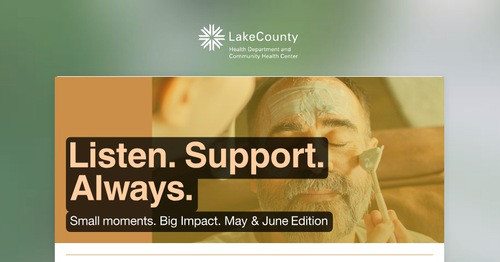
Listen. Support. Always.

Listen. Support. Always.

launch app.smore.com
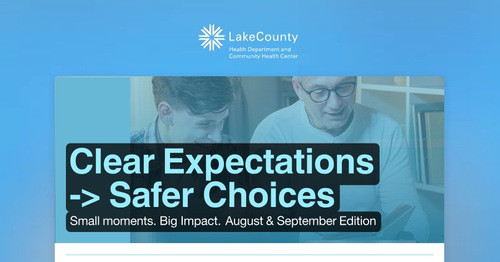
Clear Expectations -> Safer Choices

Clear Expectations -> Safer Choices

launch app.smore.com

Upcoming Events Upcoming Events

This will be updated as events are scheduled.

Brought to you by Brought to you by

User uploaded image
zoom_out_map

Lake County Health Department and Community Health Center

Email: prevention-health@lakecountyil.gov
Website: health.lakecountyil.gov
Location: 3010 Grand Ave, Waukegan, IL, USA
Phone: 847-377-8770
Facebook: facebook.com/healthdepartment
Twitter: @LakeCoHealth

User uploaded image
zoom_out_map

Community The Anti-Drug

Email: info@communitytheantidrug.org

Website: https://communitytheantidrug.org

Phone: 224-765-CTAD (224-765-2823)

Office Locations:

Deerfield & Highland Park High Schools

Mailing Address:

433 Vine Ave., Highland Park IL 60035

Funded in whole or in part by the Illinois Department of Human Services, Division of Behavioral Health and Recovery through a grant from the Substance Abuse and Mental Health Services Administration.

Lake County Health Department
Loading indicator

close

Created with

Communicate quickly and effectively with interactive newsletters.

Smore empowers educators to connect with their community, streamline school communications,
and increase engagement.

Create a newsletter