THRIVE Newsletter
#VBThrive from PGI, November 2023
Happy November! In alignment with our current Strategic Action Agenda, we will use this space to deepen our collective understanding of the science of hope. Each edition will share insights from the field, highlight stories that showcase the science of hope across our VBCPS community, and share practical strategies we can use now to fuel our professional and personal growth. As Jane Goodall said, “Hope is what enables us to keep going in the face of adversity. It is what we desire to happen, but we must be prepared to work hard to make it so.” In this edition: Fostering Self-Efficacy Hope in Action: Personalizing Advisory (Green Run High School) A Personal Hope Practice: Using 30/10 Planning to Boost Our Agency New Ways November from Action for Happiness
If someone shared this newsletter with you, please consider subscribing so that you will never miss an edition! Scroll all the way to the bottom and click on the Subscribe to Thrive button. Please consider sharing your hope stories and strategies with us directly or on social media by using #VBThrive.
Fostering Self-Efficacy
Charles R. Synder, the author of The Psychology of Hope, reminds us that our ability to see desired goals as possible is tied to our capacity to approach our goals and dreams with agency thinking. As shared in the October newsletter, agency refers to our ability to dedicate mental energy to begin and sustain the journey toward our goals. When we engage in agency thinking, we activate our self-efficacy. Self-efficacy is an individual's belief in their capacity to act in the ways necessary to reach specific goals. In fact, evidence suggests that the belief in our capacity to achieve goals may be more important to cultivating hope than knowing how to achieve those goals.
Students who build a high self-efficacy are better equipped to regard problems as challenges, set goals they commit to, attribute struggle or failure to lack of effort or as yet unlearned skills or content, and increase their efforts to achieve their goals (Withy & Hargraves, 2019). When we intentionally create learning and working environments that foster self-efficacy, we put the science of hope into action. As we head into November, it is a good time to pause and consider, in what ways am I creating regular opportunities for students and staff to build, practice, and reflect on their self-efficacy?
Through our partnership with Panorama Education, staff in VBCPS have access to the Playbook, an online professional learning library with dozens of research-based strategies and resources for fostering self-efficacy. We invite you to check out a couple of these strategies and consider how you might integrate them into your classroom, school, or office this month. (When prompted to sign in, select the “Sign in with Google” button and use your VBCPS email address.)
Growth Circles (Adults): A strategy to support participants in setting goals, growing their self-efficacy (academic or professional self-esteem), and adopting a growth mindset.
Rose-Thorn-Bud (High School): A reflection and journaling activity that supports students to set goals, become independent learners, and identify areas where they need support.
Step this Way (Middle School): An activity that explores the process of setting goals, specifically focusing on how to break down long-term into a series of smaller goals and steps.
If-Then Plans (Upper Elementary): A strategy that helps students set and meet objectives while building skills to process their emotions under stress.
Instead I (Lower Elementary): Working with everyday scenarios, students practice flexible thinking, learning that it’s possible to change their mental models and their actions.
If you have questions about the Panorama Education platform or need help securing an account, please email Angelyn.Nichols@vbschools.com. If you’d like to learn more about navigating the Fall 2023 student SEL data, which includes students’ perceptions of their self-efficacy, please register for one of the Navigating SEL Survey Data workshops currently offered in Frontline Professional Learning.
Withy, H. & Hargreaves, V. 2019. Strategies for promoting self-efficacy in students. https://theeducationhub.org.nz/strategies-for-promoting-self-efficacy-in-students/

Professional Learning Opportunity
Learn more about the science of hope by viewing a recording of Building Hope for the Future with Jamie Meade, our 2022 Speaker Series presenter. Use the keyword hope to search the catalog in Frontline to register today.
Hope in Action: Personalizing Advisory
This year, Green Run High School leadership and teachers are leveraging the science of hope through their efforts to personalize their advisory program. Before the start of the school year, teachers shared an area of passion or interest in their lives. These passion topics became the organizational structure for partnering advisors with students. When school started, students were provided a list of the topics and were asked to select the areas that piqued their curiosity and interest. Students were then placed into advisory classes where they shared a common interest with the staff member; this common interest has proved to be fertile ground for relationship building. As Battelle for Kids shares in their 15 Hope-Building Strategies (VBCPS internal resource), when we tap into students’ strengths and interests, we support students in their self-awareness and create opportunities for students to connect their experiences in school with personally meaningful goals.
This year, advisories at Green Run High School take place once a month for 60 minutes. 30 minutes are school-designed lessons that align with student SEL survey data and college and career readiness efforts. The additional 30 minutes is dedicated time for teachers and students to connect around their interest areas, such as make-up design, exploring nature, woodworking, college readiness, soccer, and travel. Many thanks to Bridgette Berthold for sharing this example of hope-building in action.
A Personal Hope Practice: 30-10 Planning
“When people engage in the right kind of planning, their success rates go up on average between 200 and 300 percent.” Dr. Heidi Grant Halvorson
One strategy we can employ to stay motivated is to practice breaking down big goals into incremental steps that bring us closer to reaching the goal. The 30-10 strategy comes from Franklin Covey. By spending 30 minutes weekly and 10 minutes daily on the following steps, the research shows we can double our productivity while increasing our motivation.
Begin the week by taking 30 minutes to…
1. Connect with your roles and goals
2. Schedule the big rocks. Big rocks are the most pressing priorities--the tasks, projects, and goals we are committed to accomplish. Follow these steps to schedule the big rocks:
Make a list at the beginning of the week of what must be accomplished that week.
Keep it short and limit yourself to 4-6 tasks.
Place the rocks across your weekly schedule in places where you are most likely to get them done.
Then daily take 10 minutes to…
Close out the day by reviewing your progress toward the big rocks.
Identify the few “must-dos” for tomorrow.
Organize those items on the calendar.
By giving ourselves time to center our priorities using the 30-10 strategy, we engage our agency by becoming the author of our story, and by scheduling time to plan and reflect on progress, we accept responsibility for taking action toward our goals.
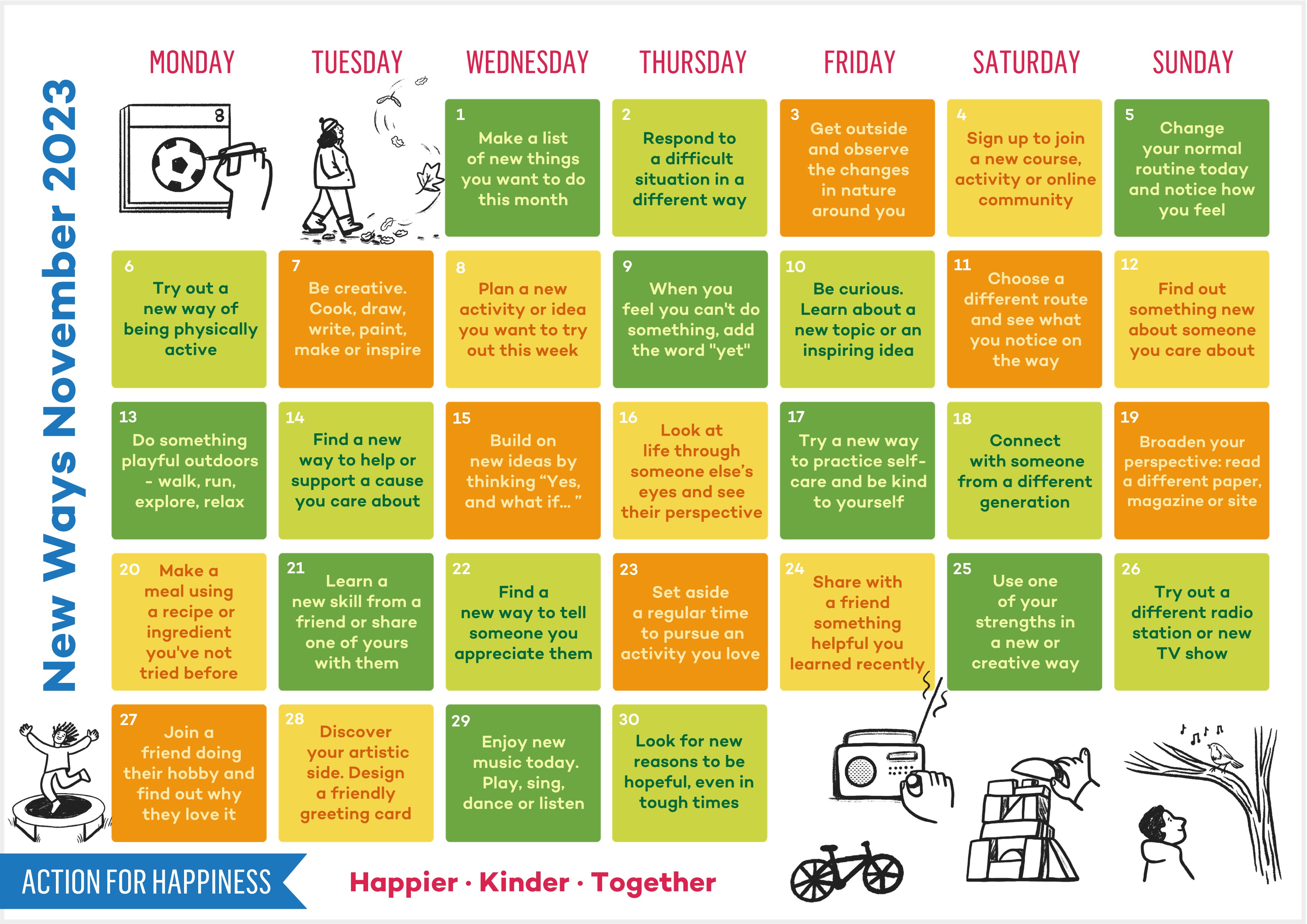
New Ways November, Action for Happiness Calendar
Vanessa King, a board member for Action for Happiness, offers three tips for November that can boost our creativity and help us practice having an open mind.
Have a micro-adventure: Enjoy a short and achievable experience in the local area that invites us to step just outside our comfort zone. For example: plan a walk in a new environment, try a restaurant with a new type of food, or visit a local landmark.
See a situation through a “new” set of eyes: Intentionally looking at the familiar from a new perspective can help us notice and appreciate our surroundings. Pause and look around while imagining you are a child, an insect, or even someone from another place in the world. What do you notice? What do you wonder about?
Carve out time to find a bit of flow: Flow is a psychological state we experience when we are completely absorbed in what we are doing. This active state is often achieved when we are engaged in doing something intrinsically engaging that is at or just above our skill level and has a clearly defined endpoint. Research has shown that even small doses of flow over the month are associated with greater happiness, fulfillment, and learning.
The mission of the Office of Professional Growth and Innovation is to benefit the students of Virginia Beach City Public Schools by promoting a culture of growth and excellence as we inspire, empower, and support all employees through multiple pathways of meaningful, innovative professional learning.