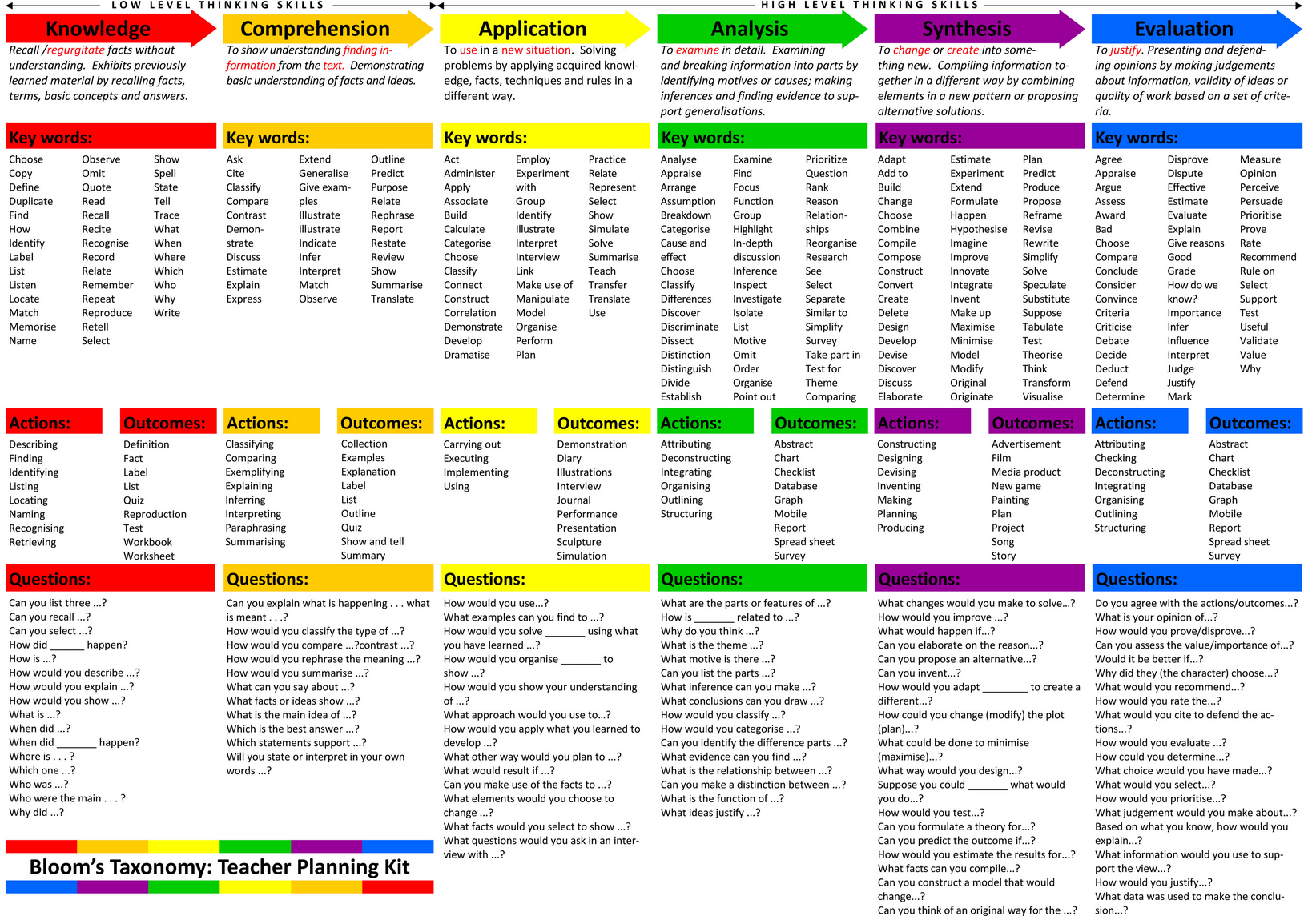

Higher order thinking skills like analysis, evaluation and creativity incorporate lower order thinking skills like remembering, understanding and applying. We aim to teach and facilitate higher order thinking skills in our teaching!
Bloom's Taxonomy of Educational Objectives, developed in 1956 by Benjamin Bloom of the University of Chicago, provides three categories of objectives: affective, psychomotor, and cognitive. The importance of the taxonomy for teachers is that it can serve to remind us of what we're asking students to do and why. In the cognitive "domain," Bloom arranges the objectives in increasing complexity, from "simple" knowledge or remembering through evaluation. The kinds of words we use in assignments often signal the level of complexity that we're asking of our students.