

The Weekly Update #4
December 17th, 2024


Welcome
Hello, I am Teaven Barnum the District Instructional Specialist for Secondary Social Studies. I'm excited to help you in any way that you need. You can reach me at teaven.barnum@killeenisd.org, text at 254-446-2873 or call my desk phone at 254-336-0253.
CONTENT
Public Comment Period for Updated Social Studies Instructional Materials Is Open
The Substitutions and Content Updates web page has been updated with a request from Houghton Mifflin Harcourt, McGraw-Hill, Savvas, and Studies Weekly to update content in their adopted social studies materials.
The public is invited to review and comment on the proposed content changes. Please submit an Instructional Materials Review and Approval (IMRA) help desk ticket if you need assistance.
Apply for Assessment Educator Committees
Each year the Texas Education Agency (TEA) invites Texas educators to provide feedback on the development of state assessments (STAAR, STAAR Alternate 2, and TELPAS) through educator committees across all assessed grades and content areas. Developing high-quality, aligned questions relies on the expertise and experience of Texas educators. Participants collaborate with other educators from across the state to review, edit, and approve each potential question for state assessments. TEA is specifically looking for educators from your region!
The commitment is generally two to three days in Austin with all travel, accommodations, and substitute coverage paid for by TEA. All participants will earn continuing professional education credits. If you are interested or know other educators who would like to participate in a committee, fill out the application form here: https://www.texasassessment.gov/educator-committees.html.
Holocaust Remembrance Instructional Resources
The mission of the Texas Holocaust, Genocide, and Antisemitism Advisory Commission (THGAAC) is to combat and confront hatred, prejudice, and indifference by educating all Texans about the Holocaust and other genocides in an effort to dismantle antisemitism and prevent such future atrocities.
Instructional resources provided by the THGAAC are available to local educational agencies throughout the year, especially during Holocaust Remembrance Week, which next occurs the week of January 27–31, 2025. During this week, Texas Education Code, §29.9072 requires public schools to provide age-appropriate instruction on the Holocaust using resources developed or approved by the THGAAC.
The THGAAC web page for Holocaust Remembrance Week provides the following resources, which can be used during Holocaust Remembrance Week as well as other times of the year:
For more information about the mission and services provided by the THGAAC and to contact the Commission, please visit the Texas Holocaust, Genocide, and Antisemitism Advisory Commission website.

Include Images to Drive Inquiry
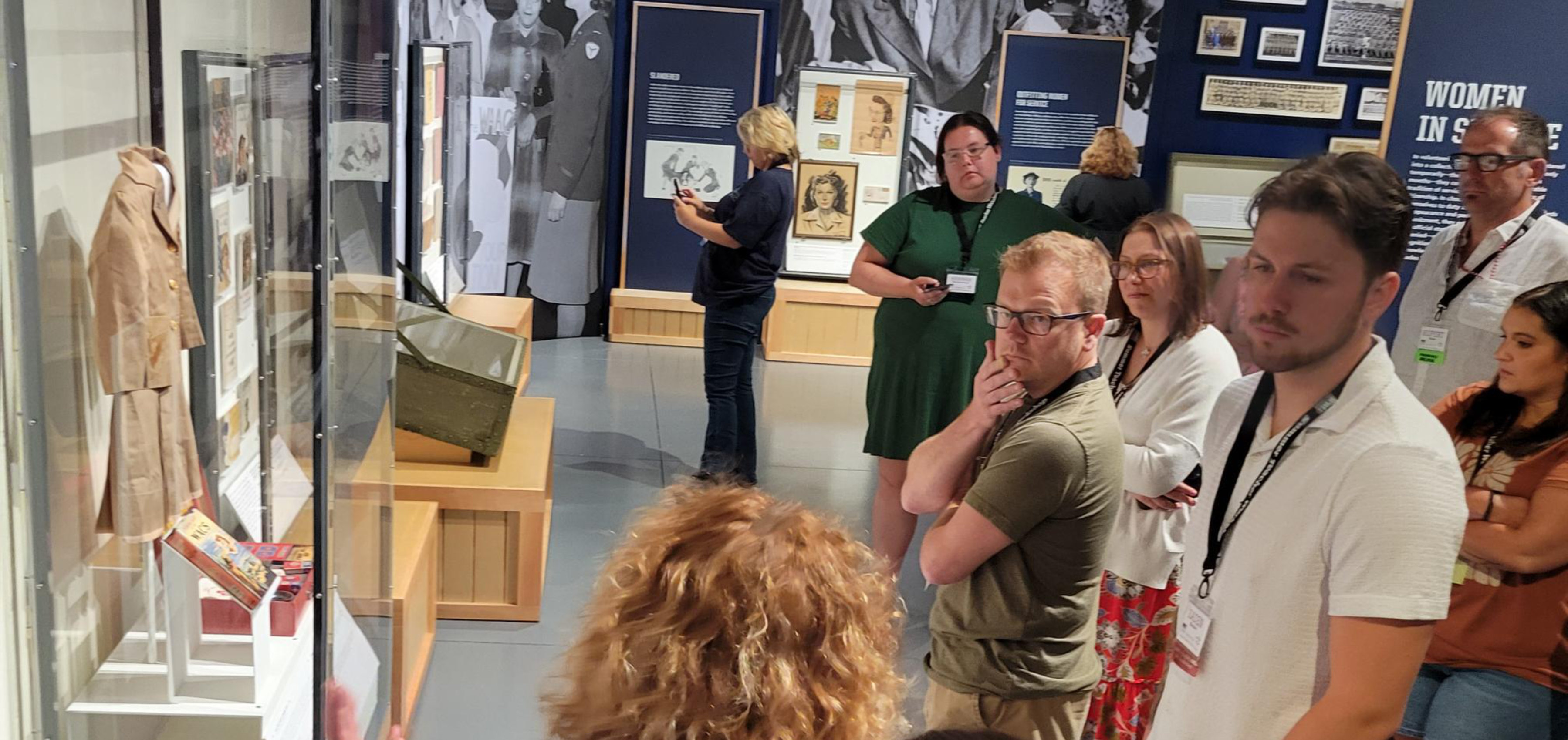
Four Quadrants is an analysis tool that pairs with primary sources to encourage curiosity through interpretation. This is low prep, easy to use, and includes multiple opportunities to get kids thinking, interacting with, and asking questions about historical content!
FOUR QUADRANTS: STEPS ⬇️
- Choose an image that has significance and enough visual content to warrant analysis.
- Leave off any identifying information (title, captions, etc.).
- Ask students to study the image for 60 seconds (no talking, writing, just looking).
- After the initial look, zoom in one one quadrant at a time. Set the timer for another minute, and then ask students to write what they see.
- Repeat for the other three quadrants.
This takes about 6 minutes total. After students have studied each quadrant, the possibilities are endless! You can ask students to compare observations, match up, create a title, find bias, evaluate details, or embed discussion that connects the image to key understandings.
FOUR QUADRANTS: WITH A TWIST ⬇️
- Look at each quadrant separately. This can be done in time chunks or by giving a separate quadrant to different groups/individual students.
- Ask students to analyze their piece of the puzzle (assigned quadrant) and find two facts, make an inference, and generate a question they have based on what they see.
- After they finish their piece, students meet up with other quadrants to discover the complete picture through observations and discussion.
- Pro Tip: Model this process for students the first time you do it so that using it in later units runs smoothly.
YOU CAN USE THIS STRATEGY TO ⬇️
- Hook students in at the beginning of a unit
- Present a significant image half way through the unit as a way to allow students to synthesize their understanding and make predictions
- Create historical context by examining the message art is sending about society
- Encourage student discourse by asking students to compare their findings with other students or class periods
- Deepen examination of a particular point of view by sourcing the visual in conjunction with the analysis activity
11th Grade Upcoming High Frequency TEKS - 3rd & 4th Nine Weeks
Here is an example of the Lowman Frequency chart. A good point of practice is to remember to emphasize standards that have been tested 5 or more times in the past. Click the link below to see the whole frequency chart with highlighted standards for the upcoming units.

8th Grade Upcoming High Frequency TEKS - 3rd & 4th Nine Weeks
Here is an example of the Lowman Frequency chart. A good point of practice is to remember to emphasize standards that have been tested 4 or more times in the past. Click the link below to see the whole frequency chart with highlighted standards for the upcoming units.

CONSISTENCY
Learn & Turn
This set of Learn & Turns will help you to better understand what it means to "Unpack" a standard. Please be sure to go over this as a PLC. The Learn & Turns are view in Schoology shown in the picture below.


"Unpacking" a standard
"Unpacking" a learning standard means breaking down a broad, often complex standard into smaller, more specific, and actionable components. This process helps teachers understand exactly what students need to know, be able to do, and at what level of rigor. It ensures clarity in planning, instruction, and assessment.
Steps to Unpack a Learning Standard:
1. Understand the Standard in Context
- Read the Standard: Read the entire standard carefully to grasp its overall meaning.
- Identify Key Terms: Highlight or underline important words (verbs, nouns, or phrases) that indicate skills, concepts, or outcomes.
- Check for Related Standards: Look at the surrounding standards to see how they connect to or build on each other.
2. Determine the Learning Goals
- Identify the Skills (Verbs): Focus on what students must do (e.g., analyze, compare, explain).
- Identify the Content (Nouns): Pinpoint the knowledge or concepts students need to master (e.g., fractions, themes in literature).
- Understand the Rigor: Use Bloom's Taxonomy or a similar framework (DOK) to determine the cognitive demand of the standard.
3. Break It Into Smaller Learning Targets
- Rewrite the standard as clear, student-friendly "I can" statements.
- Break complex standards into manageable chunks, focusing on individual skills or concepts.
4. Analyze Prerequisite Skills
- Determine the foundational knowledge and skills students need to achieve the standard.
- Identify any gaps that might require scaffolding or pre-teaching.
5. Align Instruction
- Plan instruction that targets the specific components of the unpacked standard.
6. Check for Vertical and Horizontal Alignment
- Ensure the standard aligns with the grade-level curriculum and connects logically to standards from previous or future grades.
- Align your unpacking with what peers in your grade level are doing to ensure consistency.
7. Reflect and Adjust
- Collaborate with colleagues to ensure your unpacking is accurate and comprehensive.
- Revisit and revise as you teach the standard, based on student understanding and performance.
Example: 8th Grade (8.8.B) "Explain the causes of the Civil War, including sectionalism, states' rights, and slavery."
Steps to Unpack:
1. Understand the Standard in Context
- Key Verbs (Skills): Explain
- Key Content (Nouns): Causes of the Civil War, sectionalism, states' rights, slavery
- Rigor: Requires students to provide detailed reasoning or analysis, going beyond simple identification of causes.
2. Determine the Learning Goals
Learning Objectives:
- Students will identify and define sectionalism, states' rights, and slavery.
- Students will explain how each factor contributed to the Civil War.
- Students will analyze the interplay between these factors.
3. Break It Into Smaller Learning Targets
- "I can define sectionalism, states' rights, and slavery."
- "I can describe how sectionalism created divisions between the North and South."
- "I can explain how states' rights arguments were used to justify secession."
- "I can analyze how slavery was a central issue in causing the Civil War."
- "I can connect sectionalism, states' rights, and slavery to broader tensions leading to the Civil War."
4. Analyze Prerequisite Skills
- Understanding the basic economic, social, and political differences between the North and South.
- Familiarity with the concept of federalism.
- Ability to analyze historical events for cause-and-effect relationships.
5. Align Instruction
- Create a Venn diagram comparing Northern and Southern economies and societies.
- Answer short-response questions on each contributing factor.
- Write an essay explaining how sectionalism, states' rights, and slavery caused the Civil War.
- Create a timeline showing key events that reflect these causes.
6. Check for Vertical and Horizontal Alignment
Vertical Alignment:
- Builds on prior 7th-grade knowledge of Texas' role in the Confederacy and prepares students for high school U.S. history, where the Civil War is studied in more depth.
Horizontal Alignment:
- Connects to literacy skills such as writing explanatory essays and analyzing primary sources.
7. Reflect and Adjust
- Collaborate with other 8th-grade teachers to ensure consistent depth of instruction.
- Revise as needed based on formative assessment results and student understanding.
COACHING
Professional Development



Chunk Lessons to Promote Retention
Dividing your instructional minutes into "chunks" helps students stay engaged with content because it encourages them to CHECK-IN before they can CHECK OUT. 😉
When you're planning the content of your lessons, build in stopping points along the way to give kiddos processing time and promote interaction with the learning. Something as simple as scheduling a few minutes for students to talk about the content can make a big difference in understanding and future success with retrieval!
Pro Tip: Plan your processing points up front! Intentional decisions about where to stop and what to have students think about along the way packs the biggest punch. (In other words, winging it is for the birds! 🐦)
FREE RESOURCE: Lesson Chunking Planning Tool
Use this Framework OR Make it Your Own
This free resource includes an example of chunks you might use AND a blank template for customization. Also included: comment boxes for thinking guidance! Happy planning, my friends!
If you're a paper and pencil planner, you can access the printable PDF here!

Don't make me repeat myself. -History
First person to e-mail me with the correct answer gets a prize.

Previous KISD Secondary Social Studies Newsletters
(October 2022 Newsletter) https://www.smore.com/5xkvg
(November 2022 Newsletter) https://www.smore.com/akyd6
(February 2023 Newsletter) https://www.smore.com/28pcj
(March 2023 Newsletter) https://www.smore.com/yge4w
(April 2023 Newsletter) https://www.smore.com/rfs32
(May 2023 Newsletter) https://www.smore.com/2j9zw
(August 2023 Newsletter) https://www.smore.com/cwy23
(September 2023 Newsletter) https://www.smore.com/jybau
(October 2023 Newsletter) https://www.smore.com/z3n5f
(November 2023 Newsletter) https://www.smore.com/ga5bqd
(January 2024 Newsletter) https://www.smore.com/69dk7
(February 2024 Newsletter) https://www.smore.com/n/prk0cy
(April 2024 Newsletter) https://www.smore.com/n/qrgks
(May 2024 Newsletter) https://secure.smore.com/n/1mek5
(September 2024 Newsletter) https://secure.smore.com/n/kvqj8
(October 2024 Newsletter) https://secure.smore.com/n/ngy06
(Nov./Dec. 2024 Newsletter) https://secure.smore.com/n/acrsn