
Regulation Newsletter
2024

Welcome to Volume 4 of the Emotional Regulation Smore series. To review, we have covered an overview of regulation, regulation for us as adults, and co-regulation. In this issue, we will explore ideas on how to develop, use, and implement regulation activities/strategies. These are just some ideas of different ways to utilize the resources I have compiled in the Padlet (see bottom of this Smore for the link). The possibilities are endless! Get creative!
Volume 4
Regulation in Action
Creating and Implementing Regulation Strategies
Strategies For Youth
Regulation strategies should be practiced BEFORE a behavioral crisis when a child becomes dysregulated. Here are some ideas of what/how to practice:
- Emotional literacy: the ability to recognize, understand, and respond to emotions in oneself and others in a healthy way
- Teaching, practicing, and prompting for coping strategies such as breathing exercises, mindfulness, movement
- Reading books/social stories
- Retell stories about challenging situations
- Pretend play
- See the Regulation Padlet linked below for a plethora of ideas!
Visuals
Visual supports, such as objects, photos, or drawings, add visual information to a learning environment to help children know what to do and how to interact during routines and activities. They make abstract statements and ideas more concrete for our learners.
Idea for use: Click the picture below to be taken to the website for a free download! Print and laminate the visuals and wear them on your lanyard. Teach and practice them daily with your students so that you can prompt for their use during times of emotional escalation.
Regulation Choice Boards
Choice boards are a great tool for our younger learners who may need extra prompting and visuals as they escalate.
Idea for use: Use a resource such as the one linked below. Print, laminate, cut out, and attach the coping skills via velcro. This allows you to present the resource to your student during a time of escalation and allows them to choose a regulation strategy (that has already been taught and practiced).
Utilize an AI app to help in the development of a choice board. This is an example of one created by an AI app.
Regulation Plans
Emotional regulation plans are personalized strategies that help an individual during a time of escalation. They are unique to each person and age/developmental level must be considered when developing a plan. They typically consist of the following components:
1. Identify your triggers: What situations, people, or thoughts typically lead to strong emotional reactions? Observe patterns in your emotions and identify recurring triggers.
2. Learn to recognize your emotions: Pay attention to your physical sensations when feeling strong emotions. (Example: "My hands form into fists. My stomach feels tight. My muscles tense up.") Label your emotions accurately. (*This is a great time to use an emotions chart/wheel.*)
3. Develop / learn / practice coping strategies: Mindfulness, movement, breathing, praying/meditating, journaling, positive self-talk, social support. Include what works for the individual in the plan.
4. How can others help: In the plan, include ways a trusted friend/adult can support you during your time of escalation. Do you need space? Do you need them to just sit near you in silence? Do you need them to prompt you for a coping strategy?
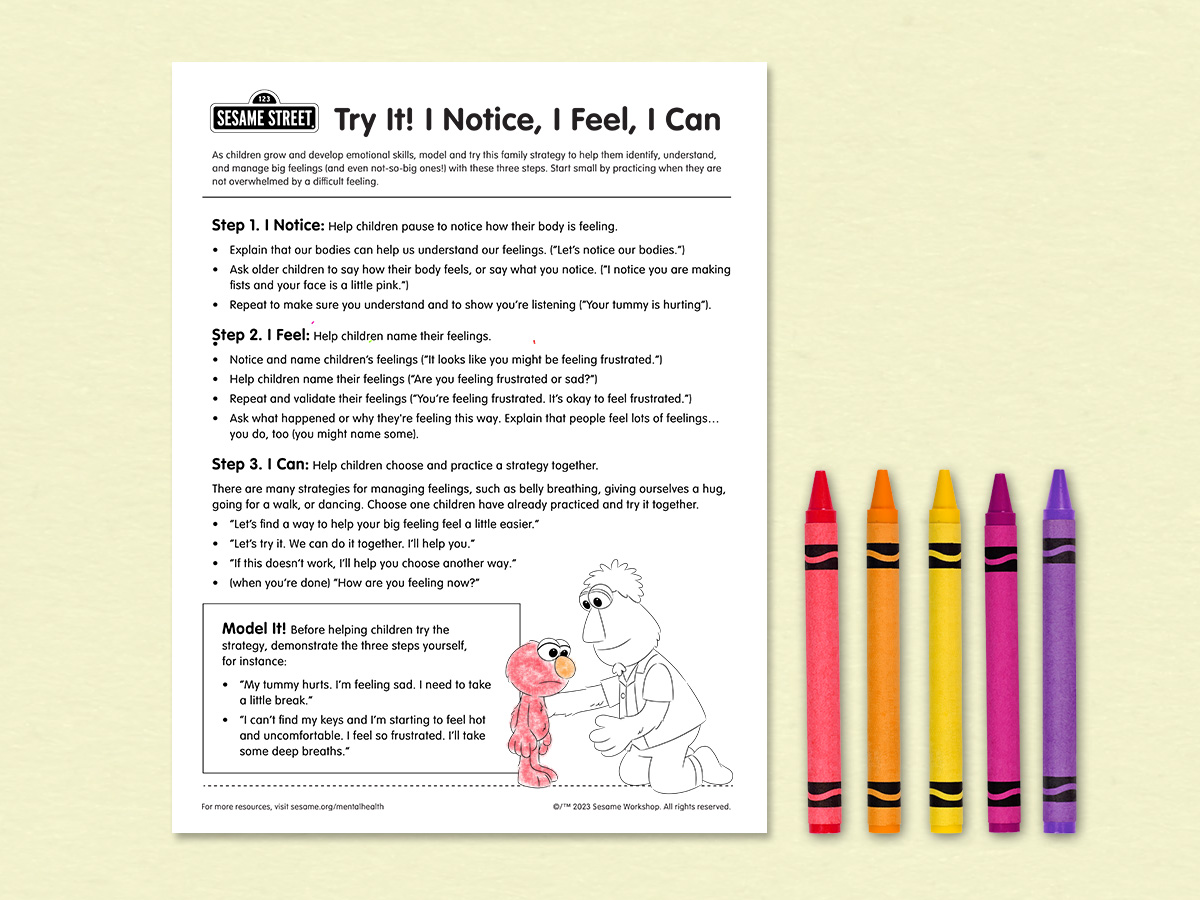
Sesame Street's Emotional Regulation Plan for Young Children
This is an easy, effective, actionable emotional regulation plan for young learners.
When children are calm, guide them to practice the three steps of “I Notice, I Feel, I Can” so they can recognize, understand, name, and manage their feelings:
Step 1. I notice… Help children pause to notice the feelings they are feeling in their body. (For instance, when we feel frustrated, our hearts might beat faster.)
Step 2. I feel… Help children name the feeling.
Step 3. I can… Help children choose a strategy to manage their feeling, and then try it.
The above link will take you to the Sesame Street website which has a video, instructions, and a fun handout.
Likert Scales
Likert scales are a great concrete visual for youth to understand their abstract feelings/moods. Likert scales provide a structured way to measure and understand their emotional state. Identifying and understanding how you're feeling is a vital step when it comes to emotional regulation.
Likert scales can also be used to track data regarding a students' mood over time. If a strategy is being implemented, we can track to see if there is improvement in the student's mood over time with the use of the Likert scale.
Helpful Resources
The "Be Good People" Life Skills website is a gold mine of resources when developing self-regulation strategies for youth of all ages.
The picture below is the Mood Meter from the website. Click the picture to be taken to the website where you can click on each identified "mood" and have it defined and have a list of coping strategies for each mood.
Sesame Street has a lot of great resources on their website as well to include articles, videos, worksheets and more! Check it out by clicking the link below.
Strategies For Adults
Setting Ourselves Up for Regulation Success as Adults
To summarize, two major factors in maintaining a consistent state of regulation for ourselves are:
1. Self-awareness (noticing/paying attention to how and what we're feeling, and then responding appropriately to meet our needs)
I say it all of the time, we are all human. We all have our own, unique experiences in this world. We have reactions to what's happening around us, and that's OK! Being self-aware is just a tool to keep our humanness in check. We may be working with a student that knows how to push all of our buttons. Our humanness is going to cause us to have emotional reactions from time to time. BUT. Being self-aware helps us to recognize that we may be being triggered. When we can recognize what's happening, we can proactively respond from the logical parts of our brain instead of react from the emotional parts of our brain. This allows us to best support our students and remain professional in the work we do.
2. Taking care of ourselves
I recently came upon the quote from Katie Reed in the picture to the right. "Self-care is giving the world the best of you instead of what's left of you." Let that sink in for a moment. Not only do the people around you deserve your best, but YOU deserve to live in a way that you feel at your best as well! Taking care of YOU is so important. It isn't selfish, it isn't unnecessary. It is intentional and you are worth it! What's your self-care plan?
"STUF"
Here is a strategy to remain mindful and self-aware - which allows you to maintain your consistent regulation.
Or maybe try using this one:
Remaining Calm and Connected in the Face of Challenging Behavior
Here's a strategy to responding to a student demonstrating challenging behavior that allows us to remain regulated and to maintain connection with our students.
Strategies for All
Breathing as a Coping Skill
Learning how to utilize breathing as a coping strategy is simple and effective! Breathing has a major impact on your body's physiology.
When you are calm and relaxed, your body is in “rest and digest” mode. You breathe normally, your heart rate is lower and your muscles are relaxed. However, when stress or anxiety or anger occurs, your body automatically switches into “flight, fight or freeze” mode. Your muscles tense up, your heart rate increases and your breathing becomes more shallow. Taking deep breaths, instead of shallow breaths, is one way to tell your body to get back to resting and digesting. That’s why deep breathing is important!
Remember, proper breathing is in through the nose, out through the mouth. (This brings in the most oxygen, and expels the most waste gases.)
Relaxation Strategies
Mindfulness
Guided imagery
5-4-3-2-1 grounding skill
Distraction Strategies
Movement Strategies
Small Body Movements
Fidgets
Big Body Movements
Taking a walk
Passing out papers
Walking on sensory steppers
Fidgets for Relaxation
Self-regulation and sensory processing are extremely intertwined because a child's ability to self-regulate can depend largely on the way the respond to the sensory input in their surroundings. Whether an individual has identified sensory needs or not, we all have our own unique sensory preferences and aversions.
Fidgets and the Brain [From Neurologic]: At NeuroLogic® we say that fidgets are “tools, not toys.” But why is this true? Let’s explore some of the brain science behind how fidgets can regulate our nervous systems, and why they often help students focus. Click the attachment below to read more!
Regulation Padlet
Looking for some resources to use for regulation? Look no further! I am always adding to this Padlet, so check back in from time to time to see what's new!
Previous Regulation Smore Volumes (1-3)
Do you have questions or are you in need of more information?
453 Maple Street
Grove City, PA 16127
724-458-6700
Midwestern Intermediate Unit IV (MIU IV) does not discriminate on the basis of sex, and prohibits sex discrimination, including sex-based harassment, in any education program or activity that it operates, as required by Title IX of the Education Amendments of 1972, 20 U.S.C. §§1681 et seq., and its regulations, 34 C.F.R. Part 106, including in admission and employment.