remove_red_eye 2.7K
page background

January DEI Newsletter

ACNL | 2025

January DEINewsletterACNL | 2025

Shaping the Future of Equitable Healthcare: The January DEI Committee Newsletter

As we usher in 2025, the healthcare landscape stands at the crossroads of innovation, equity, and adaptability. This year promises significant strides in how care is delivered, accessed, and experienced. Emerging trends—ranging from advancements in artificial intelligence to enhanced models of patient-centered care—carry immense potential to address long-standing disparities and uplift marginalized communities.


In this edition, we explore the pivotal role nurse leaders play in driving these transformative trends. By championing diversity, equity, and inclusion, nurse leaders ensure that innovation does not come at the expense of equitable care but rather serves as a tool to close gaps and build a more inclusive healthcare system. Together, let’s examine what 2025 holds and how we can collectively shape a future of health that leaves no one behind.


The DEI Committee Members:

Anitra Williams

Christina M. Oldini

Kimberly Long

Karen Mitchell-Keels

Make'da Traynum

Marshall Blue

Nicole Barnett

Sharon Goldfarb

Sheree Criner

Yury Nevarez


Newsletter produced by Vanessa Kerr and Sharon Goldfarb.

open_in_new zoom_out_map

HealthAffairs Scholar: Advancing the future of equitable access to health care: recommendations from international health care leaders

Disparities in access to health care are persistent and contribute to poor health outcomes for many populations around the world. Barriers to access are often similar across countries, despite differences in how health systems are structured. Health care leaders can work to address these barriers through bold, evidence-based actions. The Future of Health (FOH), an international community of senior health leaders, collaborated with the Duke-Margolis Institute for Health Policy to identify priority organizational and policy actions needed to improve equitable access to health care through a consensus-building exercise, a targeted literature review, and an expert discussion group. This paper describes four key action areas for health care leaders that FOH members identified as critical to enabling the future of equitable access to health care: ensuring prioritization of and accountability for equitable access to care; establishing comprehensive, organization-wide strategies to address barriers to access; clearly defining and incentivizing improvement on key measures related to reducing disparities in access; and establishing cross-sector partnerships to improve equitable access.


Read more here.

open_in_new zoom_out_map

2025 Outlook: What's driving health equity work amid Trump 2.0 uncertainty?

On the face of it, it may seem like the buzz around health equity is dying down. Less than a quarter of payer and health system executives cited health equity as a priority for 2025, a recent Deloitte survey found.


But the facts haven’t changed. The U.S. healthcare system continues to have an abysmal record on most equity, access to care and outcome metrics compared to other wealthy countries. The U.S. also far outpaces other countries on healthcare spending. By now, this is old news to everyone in the sector.


Some might argue 2024 was a year for plotting and planning: building out staff, infrastructure and strategy for equity work. Looking ahead, leaders predict 2025 will be a year for execution. Fierce Healthcare talked to more than two dozen stakeholders, including health systems, academics, health tech vendors, investors, consultants and trade groups, to understand what they expect of health equity in the next 12 months.


Here are their top four predictions.


Read more here.

Health Equity in Medical Education: A Commitment to Change

Health Equity in Medical Education: A Commitment to Change

Discover the vital role health equity plays in medical education.

launch my.clevelandclinic.org
Improving health equity through health care systems research

Improving health equity through health care systems research

To describe health equity research priorities for health care delivery systems and delineate a research and action agenda that generates evidence‐based solutions to persistent racial and ethnic inequities in health outcomes. This project was ...

launch pmc.ncbi.nlm.nih.gov
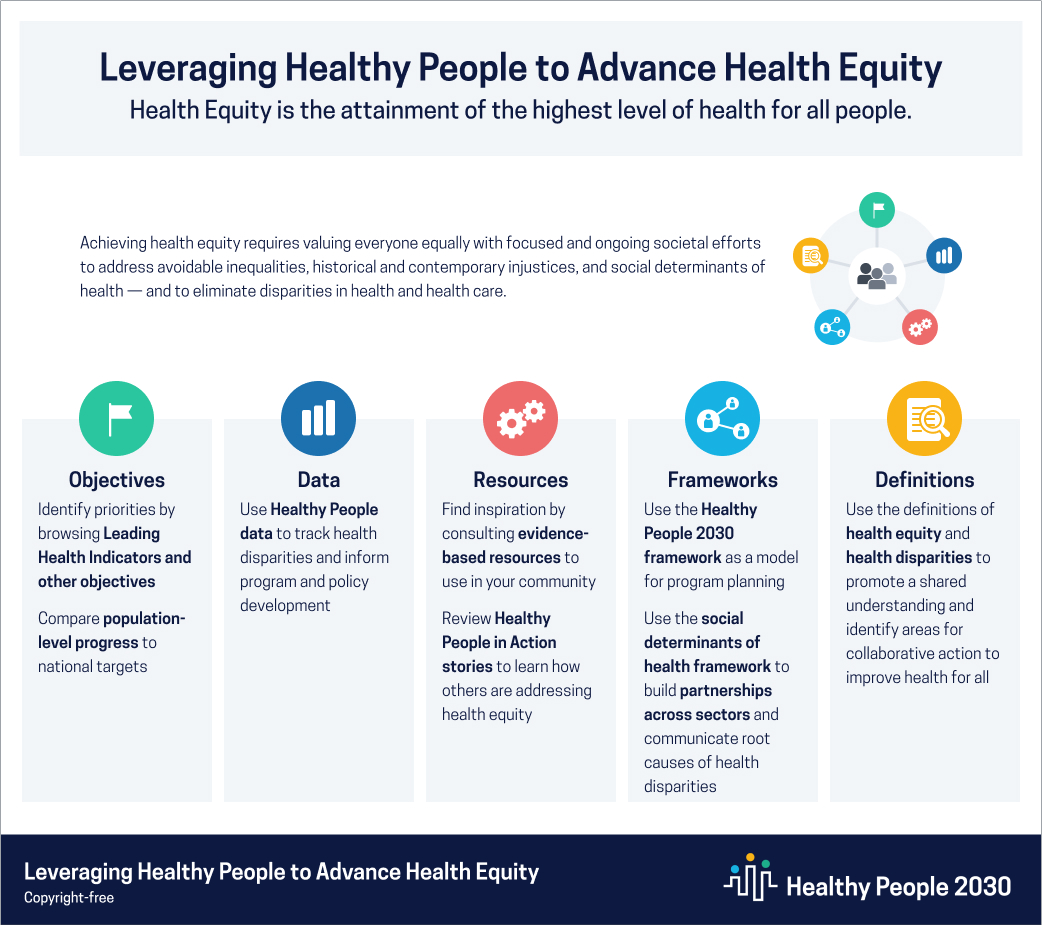
Health Equity in Healthy People 2030

Health Equity in Healthy People 2030

Health equity is defined as the attainment of the highest level of health for all people. Learn more about how Healthy People 2030 can be leveraged to advance health equity.

launch odphp.health.gov
Health equity is imperative for the future of the health of the nation - Baylor College of Medicine Blog Network

Health equity is imperative for the future of the health of the nation - Baylor College of Medicine Blog Network

Healthcare disparities in patients with allergic and immunodeficiencies and why Black and other minoritized population are disproportionately impacted.

launch blogs.bcm.edu
Top 10 Healthcare Industry Predictions For 2025

Top 10 Healthcare Industry Predictions For 2025

Sachin H. Jain's annual healthcare industry predictions covers a wide range of topics including private equity, the incoming Trump Administration, and executive turnover.

launch forbes.com
Futurescan 2025: Health Care Trends and Implications | SHSMD

Futurescan 2025: Health Care Trends and Implications | SHSMD

Futurescan 2025 is the latest in a series of publications for health care leaders, produced by SHSMD in collaboration with the American College of Healthcare Executives (ACHE) since 1999. The report is an invaluable strategic planning resource, empowering hospital and health system leaders to prepare themselves and their organizations for the opportunities and challenges ahead.

launch shsmd.org

2025 and Beyond: Shaping the Future of Equitable Healthcare

As the healthcare sector looks forward to 2025, a dynamic array of trends is emerging that promise to reshape the way care is delivered and experienced. These trends, ranging from advancements in technology to evolving care models, present a unique opportunity to address the systemic inequities that have long persisted in healthcare. Nurses, as the backbone of the industry, are poised to play a pivotal role in ensuring these innovations translate into meaningful progress for diverse communities. By staying informed, advocating for equity, and leveraging their leadership, nurses can drive impactful change.


The Integration of Artificial Intelligence and Technology

AI is transforming healthcare through predictive analytics, personalized medicine, and operational efficiencies. Tools like AI-driven diagnostic systems and virtual health assistants are streamlining workflows and improving outcomes. However, these advancements also risk perpetuating biases if not implemented thoughtfully. Nurses can advocate for inclusive data sets and equitable algorithm design. By participating in the development and implementation of AI tools, they ensure that these technologies meet the needs of underserved populations.


Expanded Access to Telehealth and Virtual Care

The telehealth boom continues, offering unprecedented opportunities to reach rural and underserved areas. However, barriers like digital literacy and internet access must be addressed to ensure equitable care. Nurses can advocate for policies that expand broadband access and provide digital health education. They can also serve as champions for integrating culturally competent practices into virtual care settings.


Focus on Mental Health and Whole-Person Care

Mental health is gaining recognition as a critical component of overall health. Integrated care models are blurring the lines between mental and physical health, emphasizing holistic approaches. Nurses can lead initiatives to destigmatize mental health care and promote culturally sensitive approaches. By fostering environments where mental health is prioritized, nurses can help bridge care gaps for vulnerable populations.


Workforce Diversity and Inclusion

A more diverse healthcare workforce is essential to delivering equitable care. Efforts to recruit and retain diverse professionals are gaining traction, yet challenges persist. As leaders and mentors, nurses can promote inclusive hiring practices and support professional development for underrepresented groups. They can also drive discussions on the importance of cultural competence in patient care.


Community-Centered Care Models

There is a growing emphasis on addressing social determinants of health (SDOH) and fostering partnerships with community organizations. These models aim to meet patients where they are and provide resources tailored to their unique needs. Nurses can advocate for funding and policies that support community-based initiatives. By actively engaging with community leaders, they can help design programs that address food insecurity, housing instability, and other critical SDOH.


To effectively navigate these trends and make a lasting impact, nurses can invest in continuous education. Staying updated on emerging technologies, policies, and care models is crucial. Pursuing training in areas like informatics and cultural competence will enhance nurses’ ability to lead.


Nurses must also foster advocacy and leadership. Nurses must leverage their voices to influence policies that prioritize equity. Joining professional organizations and participating in advocacy campaigns can amplify their impact.


Nurses should commit to lifelong learning about cultural differences and systemic inequities. Building trust with diverse patient populations is essential for delivering truly equitable care.


Collaborating with other healthcare professionals and community organizations allows nurses to tackle complex challenges more effectively. By working across disciplines, nurses can amplify their reach and impact.


The trends shaping healthcare in 2025 represent both challenges and opportunities. For nurse leaders, this is a pivotal moment to champion diversity, equity, and inclusion. By proactively engaging with emerging trends and advocating for systemic change, nurses can ensure that the future of healthcare is one where every patient—regardless of background—receives the care they deserve. Together, let us seize this moment to create a more equitable and inclusive healthcare system that leaves no one behind.

Previous Newsletters

December: Nursing History

November: Rural Healthcare

October: Disaster Preparedness

September: Political Action Edition

August: Community Health Nursing

July: Advocating for Patient Summer Safety

June: Pride Month

May: Mental Health Awareness Month

April: Disability Rights

March: Women's Health Equity

February: Environmental Health and Justice

January: Combatting Misinformation and Disinformation

December: Resilience and Community Care

November: Navigating the Digital Frontier

October: Legislative Update

September: Maternity Care

August: Civic Health Month

ACNL logo
open_in_new zoom_out_map

Association of California Nurse Leaders

Email: info@acnl.org
Website: https://www.acnl.org/
Location: 180 Promenade Circle suite 300, Sacramento, CA 95834, USA
Phone: 916-779-6949

Kimberly Long
Kimberly is using Smore to create beautiful newsletters
Loading indicator

close