
November DEI Newsletter
ACNL | 2023
Navigating the Digital Frontier: The November Edition of the DEI Committee Newsletter
As we welcome the crisp and colorful month of November, it is with great excitement that we bring you the latest edition of our Diversity, Equity, and Inclusion (DEI) newsletter. This month, we delve into a topic that has the potential to revolutionize healthcare as we know it: the use of Big Tech.
In a rapidly evolving healthcare landscape, where innovation is not only encouraged but expected, Big Tech companies have emerged as formidable players. The intersection of technology and healthcare is a realm of vast possibilities, from telemedicine and health apps to data analytics and artificial intelligence. These innovations offer us the promise of improved patient care, streamlined workflows, and enhanced accessibility.
But, as we navigate this digital frontier, it is essential that we do so with a mindful and inclusive approach. Ensuring that the benefits of Big Tech in healthcare are accessible to all, irrespective of their backgrounds, is a paramount concern. Equity must be at the forefront of our endeavors.
In this edition, we will explore how Big Tech can be harnessed to advance healthcare while addressing DEI concerns. We will discuss the potential for technology to reduce health disparities, the importance of diverse representation in tech development, and the ethical considerations that accompany these advancements.
This is not just a newsletter an opportunity to engage in meaningful and impactful dialogue and to become more educated on issues that impact the nursing profession. We invite you to join the conversation, share your insights, and, most importantly, take concrete steps to foster diversity, equity, and inclusion in the digital healthcare landscape. It is only through collective effort and thoughtful engagement that we can ensure that Big Tech contributes to a healthcare system that serves everyone.
Together, let's harness the power of technology and DEI to shape a brighter, more equitable future for healthcare.
In progress,
The DEI Committee Members:
Anitra Williams
Christina M. Oldini
Kimberly Long
Karen Mitchell-Keels
Make'da Traynum
Marshall Blue
Nicole Barnett
Sharon Goldfarb
Sheree Criner
Yury Nevarez
ACNL Annual Program Highlight - Quantum AI & Nursing
Unlock the future of healthcare at the ACNL Annual Program from February 4-7, 2024, at the prestigious Monterey Conference Center, where minds converge for a groundbreaking Brain Dating Session on February 4th from 2:30 - 4:00pm.
🧠 Dive into the Quantum AI Revolution in Nursing! 🌌
Discover the cutting-edge fusion of quantum computing and artificial intelligence in the world of nursing. Join us for an electrifying discussion that promises to reshape the very foundation of healthcare.
Learn more and register here.
THE ATLANTIC: What Big Tech Knows About Your Body
If you were seeking online therapy from 2017 to 2021—and a lot of people were—chances are good that you found your way to BetterHelp, which today describes itself as the world’s largest online-therapy purveyor, with more than 2 million users. Once you were there, after a few clicks, you would have completed a form—an intake questionnaire, not unlike the paper one you’d fill out at any therapist’s office: Are you new to therapy? Are you taking any medications? Having problems with intimacy? Experiencing overwhelming sadness? Thinking of hurting yourself? BetterHelp would have asked you if you were religious, if you were LGBTQ, if you were a teenager. These questions were just meant to match you with the best counselor for your needs, small text would have assured you. Your information would remain private.
By Yael Grauer
Continue reading here or click below.

NIHCM: Racial Bias in Health Care Artificial Intelligence
About this Data Insights
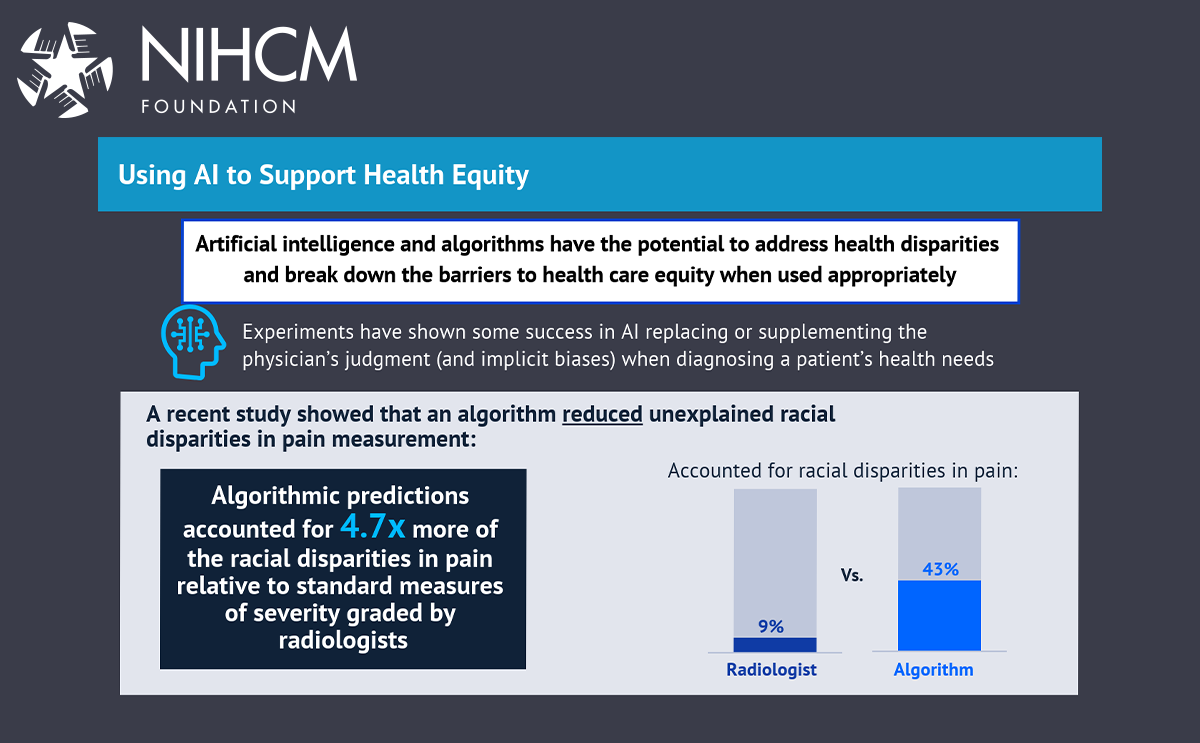
Artificial intelligence (AI) tools such as algorithms are increasingly being used to determine who gets health care. These tools can unintentionally increase the impact of existing racial biases in medicine through the explicit use of race to predict outcomes and risk. Despite evidence that race is not a reliable proxy for genetic differences, how to allocate clinical resources or treatment adherence, using race as a factor has become a common practice when designing clinical algorithms. This new infographic shows how embedding race into health care data and decisions can unintentionally advance racial health disparities and direct more attention or resources to White patients rather than Black, Latino, and other medically underserved patient populations. It also shows how health care AI tools use data that inadvertently capture systemic racism, adding to existing inequities in health care access and status.
This infographic highlights strategies to address bias in algorithms and the potential for AI to support health equity.
View here or click below.
The Revolution of Artificial Intelligence in Healthcare: Pros, Cons, and Implications
In recent years, the field of healthcare has witnessed a remarkable transformation, driven by the integration of artificial intelligence (AI) into various aspects of medical practice and research. This cutting-edge technology has ushered in a new era of diagnosis, treatment, and patient care. From predicting disease progression with unprecedented accuracy to the rapid development of groundbreaking vaccines, AI is leaving an indelible mark on the healthcare industry. However, as with any technological advancement, there are both advantages and challenges to consider.
Google researchers have made headlines by developing AI models that can predict the course of a disease and assess the risk of death during a hospitalization with an astonishing 95% accuracy rate. These AI models analyze a wide range of data, including medical records, imaging, and patient history, allowing healthcare professionals to make more informed decisions about treatment plans and interventions. Such advancements are invaluable in optimizing healthcare delivery, improving patient outcomes, and even reducing healthcare costs.
The development of COVID-19 vaccines, particularly Moderna's mRNA technology, has demonstrated the potential of AI in vaccine research and development. In the past, vaccine development often took several years, with the fastest vaccine ever developed being for Mumps in 1967, which took four years. In contrast, Moderna was able to create a highly effective COVID-19 vaccine within months, thanks to the application of AI in vaccine design and clinical trials. This breakthrough has not only saved countless lives but has also set a precedent for the rapid development of vaccines in response to emerging diseases.
The concept of a Digital Twin, or CDT (Cyber-Physical Digital Twins), is revolutionizing the healthcare sector. It involves creating a virtual replica of physical systems, such as medical devices, and using AI to simulate and predict failures and improvements. This technology enhances the efficiency and reliability of medical equipment, ensuring that devices operate optimally and reducing downtime.
Companies like Becton Dickinson and Abbott are at the forefront of developing connective devices that provide real-time data about patients' health conditions. These devices range from wearable sensors to remote monitoring equipment. As a result, healthcare professionals can closely monitor patients even from a distance, enabling early intervention and more personalized care.
The adoption of wearable technology has skyrocketed in recent years, with 1.1 billion people using such devices worldwide. These gadgets include fitness trackers, smartwatches, and health monitors, and they are transforming the way individuals manage their health. A significant 30% of middle-income households use fitness trackers, and 22% of the global population owns a wearable device, with three out of five individuals using them daily. This surge has turned the wearable technology industry into a staggering $74 billion market.
Addressing Equity and Biases in Healthcare AI
Despite the numerous advantages of AI in healthcare, it is essential to recognize that this technological shift is not without its challenges. One critical concern is the potential for AI to perpetuate and exacerbate existing biases. AI systems learn from historical data, and if this data is biased, it can lead to discriminatory outcomes in healthcare. The role of humans behind the screen, including data collection and model development, plays a significant role in perpetuating biases. It's essential to continually assess and mitigate these biases to ensure that AI serves all individuals equitably.
Healthcare AI systems often rely on vast datasets that may contain biases due to historical practices. For example, if certain demographic groups have been underrepresented in medical research or have received differential treatment, the data can reflect these disparities. As a result, AI algorithms may make decisions that perpetuate these biases, leading to unequal healthcare outcomes for different populations. The design and training of AI algorithms can introduce biases, often unintentionally. The algorithms learn from patterns in the data, and if these patterns are biased, the AI may make decisions that disproportionately affect certain groups. For instance, a predictive healthcare model might allocate more resources to patients of one ethnicity over another due to skewed historical data.
To address these biases, healthcare providers and researchers often seek to collect and analyze vast amounts of sensitive patient data. This presents significant data privacy and security concerns. Patients may be hesitant to share their health information if they are not assured of data protection, which can limit the quality and quantity of data available for AI applications.
The ethical dilemmas surrounding AI in healthcare are complex. Questions arise about who is responsible when an AI system makes a biased decision. Additionally, the trade-off between privacy and the need for AI training data poses ethical challenges. Equity in healthcare AI means ensuring that all populations, regardless of their demographic or socioeconomic background, have equal access to the benefits of AI-driven healthcare. However, many people, particularly those in underserved communities, may lack access to the technology or healthcare services that rely on AI, leading to disparities in healthcare outcomes.
Governments and industry organizations are increasingly recognizing the need for guidelines and regulations to ensure AI fairness and equity in healthcare. These standards can help establish best practices and provide a framework for addressing biases and privacy concerns. Transparency in AI decision-making is essential. Healthcare organizations and AI developers should be transparent about how AI systems work, the data they use, and the criteria they use for decision-making. Accountability mechanisms should also be in place to address any issues that may arise.
The potential benefits of AI in healthcare are substantial, from improved diagnostics to more efficient treatment plans and better patient outcomes. However, addressing equity and biases is essential to ensure that these advancements are accessible and beneficial to all. By actively acknowledging and working to rectify biases in healthcare AI, we can build a healthcare system that is not only technologically advanced but also equitable and inclusive. This will ultimately lead to better healthcare outcomes for everyone, regardless of their background or demographic.
NPR: AI could help detect irregular heart rhythms in EKGs that humans can't see
Read more below or by clicking here.

ACLU: Algorithms Are Making Decisions About Health Care, Which May Only Worsen Medical Racism
Read more here or click below.

HealthImpact’s DAISY Nurse Leader Award for Policy
In 2020, the DAISY Foundation partnered with HealthImpact to create an award to honor nurses whose work advances compassionate care in policy. Registered Nurses at DAISY partner facilities with any degree who have demonstrated work in policy, whether it is in their job description or done externally to the institution, are eligible to be nominated for this recognition. Policies that affect local, regional, national, or global populations through legislation, checklists, guidelines, regulations, standards of practice, etc. will be considered. Honorees will be chosen by a panel of reviewers whose expertise is relevant to advancing compassionate care in policy.
Application now open! Click here to complete the form. The deadline for nominations is December 3rd, and recipients will be notified in early February 2024.


Association of California Nurse Leaders
Email: info@acnl.org
Website: https://www.acnl.org/
Location: 180 Promenade Circle suite 300, Sacramento, CA 95834, USA
Phone: 916-779-6949