


Family Life/Lessons
Monroe County Schools Coordinated School Health 2026-2027
Acknowledgements

Welcome,
Located below is information regarding Family Life instruction and lessons for Monroe County Schools. If you have any questions please reach out to your school's principal, CSH District Coordinator- Lacey Thompson lacey@monroek12.org or School Health Supervisor-Jackie Gray grayj@monroek12.org
What is Family Life?
“Family Life Education” means an abstinence-centered sex education program that builds a foundation of knowledge and skills relating to character development, human development, decision making, abstinence, contraception and disease prevention.
Source: TCA 49-6-1301
We are a abstinence-centered school district.
Standards
Family Life Laws
TCA 49-6-1301; TCA 49-6-1302; TCA 49-6-1303; TCA 49-6-1304; TCA 49-6-1305; TCA 49-6-1306; TCA 49-6-1307; TCA 49-6-1308
TCA LAWS
Tennessee Code Title 49. Education 49-6-1301
Tennessee Code Title 49. Education § 49-6-1301
Current as of January 02, 2024 | Updated by FindLaw Staff
As used in this part, unless the context otherwise requires:
(1) “Abstinence” means not participating in any activity that puts an individual at risk for pregnancy or a sexually transmitted disease;
(2)(A) “Abstinence-based” or “abstinence-centered” means an approach that promotes sexual risk avoidance, or primary prevention, and teaches vital life skills that empower youth to identify healthy and unhealthy relationships, accurately understand sexually transmitted diseases and contraception, set goals, make healthy life decisions, and build character;
(B) Abstinence-centered education is a holistic approach that addresses the physical, social, emotional, psychological, economic and educational consequences of nonmarital sexual activity;
(3) “Abstinence-centered curriculum” means that the majority of the content of a curriculum promotes sexual risk avoidance as the primary goal. Supplemental topics in the curriculum, such as healthy relationships and substance abuse, reinforce the goal of primary prevention;
(4) “Age-appropriate” means designed to teach concepts, information and skills based on the social, cognitive, emotional and experience level of most students at a particular age level;
(5) “Evidence-based approach” means an approach:
(A) That has a clear theoretical base that integrates research findings with practical implementation expertise that is relevant to the field;
(B) That matches the needs and desired outcomes for the intended audience; and
(C) That if implemented well, demonstrates improved outcomes for the intended audience;
(6) “Family life education” means an abstinence-centered sex education program that builds a foundation of knowledge and skills relating to character development, human development, decision making, abstinence, contraception and disease prevention;
(7) “Gateway sexual activity” means sexual contact, as defined in subdivision (14), that could precipitate engagement in a nonabstinent behavior. A person promotes a gateway sexual activity by encouraging, advocating, urging or condoning gateway sexual activities;
(8) “Gender identity” has the same meaning as provided in the Diagnostic and Statistical Manual (DSM-5);
(9) “Medically accurate” means information that is grounded in evidence-based, peer-reviewed science and research;
(10) “Parent” means the parent, guardian, person who has custody of the child, or individual who has caregiving authority under § 49-6-3001;
(11)(A) “Puberty” means a developmental stage during which the pituitary gland triggers the production of testosterone in boys and the production of estrogen and progesterone in girls;
(B) Puberty typically begins in girls between nine (9) and twelve (12) years of age, and in boys between eleven (11) and fourteen (14) years of age;
(C) Puberty is the period during which adolescents become capable of reproduction and experience various bodily changes;
(12) “Risk avoidance” means an approach that encourages the prevention of participation in risk behaviors as opposed to merely reducing the consequences of those risk behaviors;
(13) “Sexual activity” means sexual penetration or sexual contact, or both;
(14) “Sexual contact” means sexual contact as defined under § 39-13-501;
(15) “Sexual intercourse” means that a male reproductive organ is inserted into any bodily orifice;
(16) “Sexual orientation” means an individual's actual or perceived sexual orientation as heterosexual, homosexual, or bisexual; and
(17) “Sexually transmitted disease” (STD) means a disease that is caused by bacteria, virus or parasite that is transmitted from one person to another during sexual contact. A sexually transmitted disease is also referred to as a sexually transmitted infection (STI).
Link to public chapter law
Monroe County Board of Education Policy
Monroe County Schools Implementation Timeline for 2026-2027 School Year
Staff Training- FALL 2026
Parent Consent Letter- Grades 5th - High School 09/08/2026 due back:
Instruction window begins Fall 2026 (dates will vary by schools, please check with each school)-
Family Life Parent Letter
The parent letter will be delivered to schools on: Friday August 14th, for the 2026–2027 school year, the date of return to schools: September 1, 2026.
Lessons
Videos featured in lessons
Brainpop-Hygiene (5th grade)
Consent (6th-8th grade)
DHS-What is Human trafficking (6th-8th grade)

Baby Olivia video (6th grade & up)
5th grade lesson
6th grade lessons
7th grade lessons
8th grade lessons
High School Lessons
WellnessClass(HighSchoolCredit)
Our Wellness classes use Goodheart-Willcox textbook which has been approved by TN Department of Education and Monroe County Schools. We've also adopted the curriculum below from Loudon County Schools.
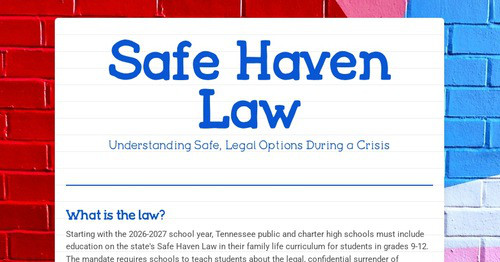
Safe Haven Law
Questions
We welcome you to reach out to your school's principal, Ms. Lacey Thompson lacey@monroek12.org Monroe County Schools CSH District Coordinator or School Health Supervisor Ms. Jackie Gray grayj@monroek12.org. We welcome you to e-mail, call, or set up an appointment.


