
Smore logo
remove_red_eye 1.3K
page background

Fact-Checker Websites

News Literacy Tools

Fact-Checker Websites News Literacy Tools
Fact-CheckerWebsitesNews Literacy Tools

What is Fake News?

This newsletter highlights the various fact-checker tools available to help readers decipher the accuracy of news media stories. The Fact-checking Websites, the CRAAP Test, and Lateral Reading are tools you may use to evaluate sources of information.


"The Internet is full of viral misinformation. Fake news is a false story designed to look like credible information, making it difficult to decipher fact from fiction. Fake news typically spreads fast online. How can we wade through it? Always reflect on how you encountered the story. Was it promoted on a website? Did it show up in a social media feed? Was it sent to you or by someone you know? Trace the story to its original source." Arlington Heights Memorial Library https://www.ahml.info/node/100004857

Fact-Check Websites Fact-Check Websites

open_in_new zoom_out_map

FactCheck.org

We are a nonpartisan, nonprofit “consumer advocate” for voters that aims to reduce the level of deception and confusion in U.S. politics. We monitor the factual accuracy of what is said by major U.S. political players in the form of TV ads, debates, speeches, interviews and news releases.
open_in_new zoom_out_map

Snopes

This is the oldest and largest fact-checking website. Snopes.com’s fact checking and original, investigative reporting lights the way to evidence-based and contextualized analysis.
open_in_new zoom_out_map

SciCheck.org

FactCheck.org’s SciCheck feature focuses exclusively on false and misleading scientific claims that are made by partisans to influence public policy. It was launched in January 2015 with a grant from the Stanton Foundation.

Website Summaries

Polger, Mark Aaron. “Misinformation and Disinformation: Thinking Critically about Information.” CSI Library, College of Staten Island-The City University of New York, 13 Oct. 2024, library.csi.cuny.edu/c.php?g=619342&p=4310783.

The Washington Post Fact Checker The Washington Post Fact Checker

open_in_new zoom_out_map

The Washington Post Fact Checker Quick Guide Video The Washington Post Fact Checker Quick Guide Video

The 'Pinocchio test:' A Fact Checker quick guide

The 'Pinocchio test:' A Fact Checker quick guide

For over fifteen years, The Fact Checker has been paying close attention to the halls of Washington, D.C., and beyond to help keep power to account.

launch washingtonpost.com

More Fact-Check Websites More Fact-Check Websites

open_in_new zoom_out_map

NPR Fact Check

NPR (national public radio) is an independent, nonprofit media organization that was founded on a mission to create a more informed public.
open_in_new zoom_out_map

Media Bias

Media Bias/Fact Check (MBFC), founded in 2015, is an independent online media outlet. MBFC is dedicated to educating the public on media bias and deceptive news practices. MBFC’s aim is to inspire action and a rejection of overtly biased media. We want to return to an era of straight forward news reporting.
open_in_new zoom_out_map

Politifact

Fact-checking journalism is the heart of PolitiFact. Our core principles are independence, transparency, fairness, thorough reporting and clear writing. The reason we publish is to give citizens the information they need to govern themselves in a democracy.

Website Summaries

Polger, Mark Aaron. “Misinformation and Disinformation: Thinking Critically about Information.” CSI Library, College of Staten Island-The City University of New York, 13 Oct. 2024, library.csi.cuny.edu/c.php?g=619342&p=4310783.

How to Spot Fake News Checklist How to Spot Fake News Checklist

open_in_new zoom_out_map

Watch the Following on How to Conduct a Google Reverse Image Search Watch the Following on How to Conduct a Google Reverse Image Search

How to Use Google Reverse Image Search to Fact-Check Images | Common Sense Education

How to Use Google Reverse Image Search to Fact-Check Images | Common Sense Education

How to Use Google Reverse Image Search to Fact-Check Images is a video from Common Sense Education. Use this video to help your students learn and thrive in our connected world.

launch commonsense.org

Tutorial: How to Fact-Check Images Online Tutorial: How to Fact-Check Images Online

TUTORIAL: How to fact-check images online
pdf
insert_drive_file
document-reverse-image-search-3.pdf
Use the step-by-step guide handout
Download
286.8 KB

Strategies For How to Spot Fake News -Video Strategies For How to Spot Fake News -Video

How to Spot Fake News - FactCheck.org

Evaluating Resources: The CRAAP Test

These resources provide relevant questions for evaluating resources.

CRAAP Checklist for Evaluating information CRAAP Checklist for Evaluating information

CRAAP Test Evaluation Rubric CRAAP Test Evaluation Rubric

Evaluating Sources
Most Reliable and Credible Sources for Students | Common Sense Education

Most Reliable and Credible Sources for Students | Common Sense Education

Most Reliable and Credible Sources for Students is a list of 27 apps, games, and websites curated by Common Sense Education editors.

launch commonsense.org
Help Your Students Fact-Check the Web Like Professionals | Common Sense Education

Help Your Students Fact-Check the Web Like Professionals | Common Sense Education

Help Your Students Fact-Check the Web Like Professionals is a video from Common Sense Education. Use this video to help your students learn and thrive in our connected world.

launch commonsense.org

Breaking News Consumer's Handbook Fake News Edition Breaking News Consumer's Handbook Fake News Edition

open_in_new zoom_out_map

Research Guides: How to Evaluate Information Sources: Critical questions for evaluating your sources

Research Guides: How to Evaluate Information Sources: Critical questions for evaluating your sources

launch libguides.usask.ca

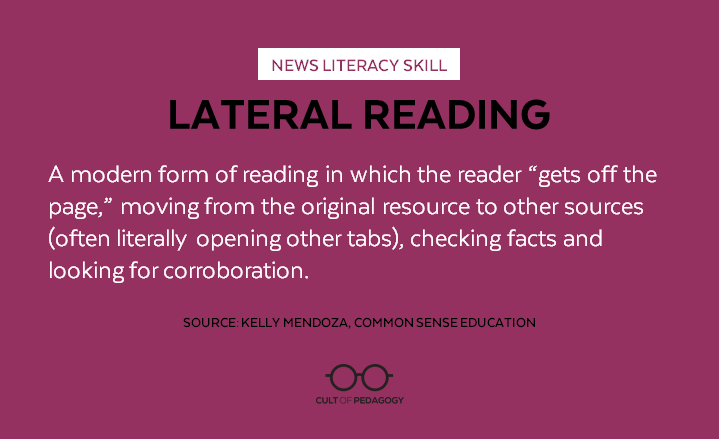
Lateral Reading Lateral Reading

Lateral Reading
open_in_new zoom_out_map

Watch the following videos on lateral reading. Following the video, use the lateral worksheet to help you evaluate a source.

Sort Fact from Fiction Online with Lateral Reading
Intro to Lateral Reading - Teaching Online Fact-Checking
pdf
insert_drive_file
Lateral Reading Poster Guide.pdf
Download
41.7 KB
pdf
insert_drive_file
Lateral Reading in Spanish Poster .pdf
Download
48.8 KB
pdf
insert_drive_file
Lateral Reading Worksheet.pdf
Download
144.4 KB
pdf
insert_drive_file
Lateral-Reading-Handout-Infographic .pdf
Download
1.2 MB
open_in_new zoom_out_map

Question Your Sources Question Your Sources

This resource by Monash University provides a step-by-step guide for using critical thinking skills to assist with evaluating information.

The News Literacy Project -Checkology

Checkology empowers students to identify credible information and understand the importance of a free press. Students who are news-literate make informed judgments about the credibility, accuracy, and context of information. They learn to distinguish evidence and facts from rumors, viral hoaxes, conspiracy theories, and misinformation. Being well-informed about current events and the role of the news media in shaping public discourse is vital for students to be responsibly engaged in civic life. “The News Literacy Project.” Checkology, 29 July 2024, get.checkology.org/.


Instructions:

Click on the Checkology Misinformation Interactive Activity, and follow the lesson.


1. Click on Join.

2. Click on Register with Name and Password.

3. Type in First Name, Last name.

4. Type in the following password : Fmaliteracy25*. You will have to re-enter the password.

5. Type in School Email address w/out the zeros..

6. Click on Register.

7. When the blue screen appears, write down the username and password given by Checkology and

take a snapshot.

8. Click on Got it.

8. Complete the Pre-Assessment Survey first.

9. Once the survey has been completed, click on Fake Misinformation to begin the activity.

Checkology Misinformation Interactive Activity Checkology Misinformation Interactive Activity

Keep Your Students (and Yourself) Safe on Social Media: A Checklist Infographic Keep Your Students (and Yourself) Safe on Social Media: A Checklist Infographic

Additional Resources Additional Resources

Student Handout-Fearless Fact-Finding

https://www.commonsense.org/sites/default/files/pdf/2018-08/fearless-fact-finding.pdf

Turn Students into Fact Finding Web Detectives by Common Sense Media

https://www.commonsense.org/sites/default/files/pdf/2018-02/document-edtechtips-turnstudentswebdetectives-release_0.pdf

Evaluating Information: Who, Why, When, Where, How and What

https://wit-ie.libguides.com/ld.php?content_id=30999025

Dr. Clara Bannister, PhD

Franklin Military Academy

Library Media Specialist

cbannist@rvaschools.net

Clara Bannister
Clara is using Smore to create beautiful newsletters
Loading indicator

close

Created with

Communicate quickly and effectively with interactive newsletters.

Smore empowers educators to connect with their community, streamline school communications,
and increase engagement.

Create a newsletter