

Smore logo
remove_red_eye 559
page background

The Six-Step Vocabulary Process

Marzano's Strategy for Teaching Vocabulary

The Six-StepVocabulary ProcessMarzano's Strategy for Teaching Vocabulary

Overview of the Six-Step Vocabulary Process

Marzano's Six-Step Vocabulary Process uses multiple ways of engaging with new terms in order to increase student vocabulary. According to an article in Teaching for the 21st Century (September 2009), research showed that the use of the six-step strategy works across grade levels and works best when all six steps are used. The first three steps are used in the introduction of new terms, while the last three steps are used in any order once new terms are taught as a way of shifting new terms to long-term memory.

Step 1: Explain (Teacher) Step 1: Explain (Teacher)

Provide a student-friendly description, explanation or example

When giving students the meaning of a new word, the student-friendly definition should be conversational and informal. It doesn't mean having students look it up in a dictionary and copy it or copying a definition from the screen. Some ideas to give students a better understanding of a new term:


  • tell a story using the word
  • show a short video that utilizes or expresses the meaning behind a term
  • share your own mental picture of the word


For example, a teacher wanting to teach the term "parallel" might talk to students about the painted lines on a road being parallel, explaining that those lines will never intersect and stay the same distance apart.

Step 2: Restate (Student) Step 2: Restate (Student)

Ask students to restate it in their own words

A key to moving to vocabulary to students' short-term memory is having students restate it in their own words. They might record this definition on a graphic organizer, notecard or vocabulary notebook (which you can learn more about in the video below).

6 Traits of Writing | Professional Development by Smekens Education - Maintain Vocabulary Notebooks

6 Traits of Writing | Professional Development by Smekens Education - Maintain Vocabulary Notebooks

Students should maintain their thinking about discipline-specific terms in an on-going resource — like a vocabulary notebook.

launch smekenseducation.com

Step 3: Show Step 3: Show

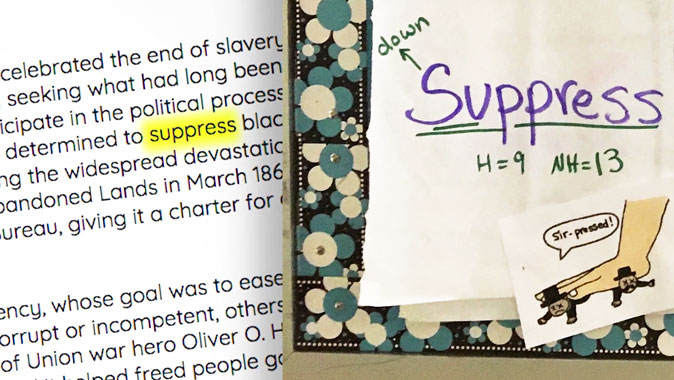
Ask students to construct a picture, symbol, or graphic representing the term

To move vocab to long-term memory, it must have linguistic and nonlinguistic representations. If you think back to how our brains work, you might remember that vocabulary is the system of file folders our brain uses to categorize and sort new learning. Without those terms, the sensory register pushes new information out of the brain.


This isn't necessarily a skill students already have, so it is important for teachers to model, model, model. Another tool that can be utilized in this step is collaboration.

Representing Knowledge Nonlinguistically
Robert J. Marzano

Step 4: Interact Step 4: Interact

Engage students periodically in activities that help add to their knowledge of vocabulary terms

The types of activities in this step are fairly broad, but all of them allow students to interact with the terms in an effort to make deeper connections.

Some of these activities include:

  • analogies
  • similarities/differences
  • warm ups
  • similes/metaphors
  • word parts
  • synonyms/antonyms
  • classifying


These activities serve as a cumulative review of the 20-30 terms deemed critical for the grade level and subject area. Keep in mind that students require 3-4 exposures and interactions with new terms in order to process and keep those terms in the memory.

Total Physical Response Vocabulary

Total Physical Response Vocabulary

Using the Total Physical Response method to teach vocabulary. The TPR strategy is very useful, especially when teaching English Language Learners.

launch teachingchannel.org

Step 5: Discuss Step 5: Discuss

Periodically ask students to discuss the terms with one another

Having students discuss the terms with one another is another way to have students interact with the words. It can also help clarify the connotations of some words. Some ideas to try:

  • Have students compare descriptions of the same words
  • Have students describe the pictures or symbols they drew
  • Have students connect words to other terms/content

An example of how you might do these things would be with a "speed dating" bell ringer. Students would quickly meet with several students to do one of the above tasks for a given word or set of words.
Vocabulary Discussion to Teach Word Meanings - InferCabulary

Vocabulary Discussion to Teach Word Meanings - InferCabulary

launch infercabulary.com

Step 6: Games Step 6: Games

Involve students periodically in games that allow them to play with the terms

There are lots of games that students can play using vocabulary terms. These games help students engage with the words, understand them more deeply, and increase retention.

  • Talk a Mile a Minute: One student gives clues about a vocabulary term in an effort to get the team to guess the correct word.
  • Taboo: Similar to Talk a Mile a Minute, one student tries to get another to guess the vocabulary word by giving clues. However, there is a list of words/phrases the student can not use.
  • Which One Doesn't Belong?: Using a list of vocabulary words, students decide which should not be on the list and identify the why.
  • Tri-bond: Looking at 3 terms, students identify a common bond.


One of the great things about these games is that little prep is needed. These games are a great way to increase exposure to the terms and have students think critically about their meanings.


If you need yet another reason to use games with vocabulary, research shows that the use of academic games results in a 13-18 percentile gain in student growth.

9 Classroom Vocabulary Games to Use with Your Students

9 Classroom Vocabulary Games to Use with Your Students

Looking for some fun classroom vocabulary games to use with your students? Try these 9 quick and easy vocabulary review games.

launch schools.magoosh.com
Pine Crest Vocab Comes Alive Grades 4-5 — Learning in Hand with Tony Vincent

Pine Crest Vocab Comes Alive Grades 4-5 — Learning in Hand with Tony Vincent

Learning academic terms and phrases doesn’t have to be boring. In fact, learning new words should be exciting and fun! It’s time to start looking at digital ways to expand students’ vocabulary. Let’s explore apps and websites that are so irresistible, students can’t help but be motivated to learn. We’ll take a good look at representing words visually, creating multimedia, and playing games. Yes, the technology can be mesmerizing, but it’s important to use techniques and strategies proven to work. That’s why pairing technology with Robert Marzano’s Six Steps for Vocabulary Instruction is a powerful combination.

launch learninginhand.com
Closing the Vocabulary Gap
zoom_out_map

Region 9 HRS Team

Shane Porter shane.porter@esc9.net

Angie Betts angie.betts@esc9.net
Marisa Hafley marisa.hafley@esc9.net

Lynn Hall lynn.hall@esc9.net
Miranda Havins miranda.havins@esc9.net

Christy Johnson christy.johnson@esc9.net

Lori Phillips lori.phillips@esc9.net

Email: christy.johnson@esc9.net
Website: www.esc9.net/HRS
Location: 301 Loop 11, Wichita Falls, TX 76308
Phone: (940)322-6928
Twitter: @R9_HRS

Loading indicator

close

Created with

Communicate quickly and effectively with interactive newsletters.

Smore empowers educators to connect with their community, streamline school communications,
and increase engagement.

Create a newsletter