
Smore logo
remove_red_eye 71
page background

LC Lab

LC Lab

Circuit Construction Kit: AC

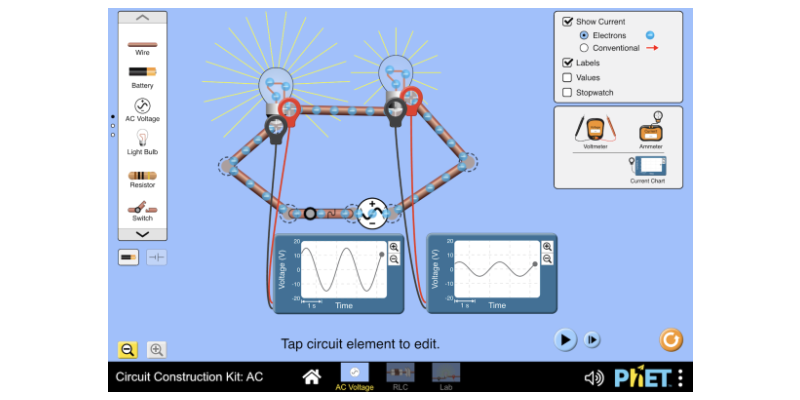
Experiment with an electronics kit! Build circuits with batteries, resistors, ideal and non-Ohmic light bulbs, fuses, and switches. Build circuits with AC voltage sources, batteries, resistors, capacitors, inductors, fuses, and switches. Take measurements with a lifelike ammeter and voltmeter and graph the current and voltage as a function of time. View the circuit as a schematic diagram or switch to a lifelike view.

launch phet.colorado.edu

Launch the Circuit Construction Kit simulation - Select RLC Launch the Circuit Construction Kit simulation - Select RLC

Purpose

Qualitatively investigate the behavior of LC circuits.

Materials

internet and computer

Part 1 Part 1

User uploaded image
zoom_out_map

Procedure

  1. Open the simulation and select RLC.

  2. Construct the circuit to the right.

  3. Set values to:
    V = 10 volts

    R1 = 25 ohms
    C = 0.2 farads
    L = 10 henries
  4. A capacitor, C, stores charge, Q. What is the equation that gives the energy stored in a capacitor.

  5. An inductor, L, carries a current, i. What is the equation that gives energy stored in an inductor.

  6. Close switch S1 and open switch S2. Once the capacitor is fully charged open switch S1 and close switch S2. Observe the periodic charging and discharging of the capacitor and inductor.

  7. Graph and identify the energy stored in the capacitor and inductor for one period on the axis below.

User uploaded image
zoom_out_map Show in original size

8. Draw a curve representing the total energy of the LC system.

Derivation Derivation

These energy oscillations should look identical to the mechanical energy oscillations of a mass on a spring. Recall the following derivation.

User uploaded image
zoom_out_map Show in original size

Part 2 Part 2

User uploaded image
zoom_out_map
  1. Insert a light bulb for R2.
  2. Set values to:
    V = 20 volts
    R1 = 25 ohms
    R2 = 1 ohm
    C = 0.2 fards
    L = 10 henries
  3. Recharge the capacitor and observe the periodic charging and discharging of the capacitor and inductor.
  4. Does dE/dt = 0. If no, what does it equal?
  5. Write an expression for the charge as a function of time, q(t).
David Carroll - Plano West
www.GravityKills.net
Loading indicator

close

Created with

Communicate quickly and effectively with interactive newsletters.

Smore empowers educators to connect with their community, streamline school communications,
and increase engagement.

Create a newsletter