Smore logo
remove_red_eye 151
page background

Lieck Elementary Counselor Corner

January 2024

Lieck Elementary Counselor Corner January 2024

Happy New Year Lieck Families!! We hope your winter break was filled with all of the things that bring you peace and joy and that you are feeling refreshed in the new year.

The Counseling Department is excited to welcome you back to campus and start off 2024 with a fresh mindset! We cannot believe we are already almost halfway through the school year! What better way to embark on a new year and new semester with setting time to self-reflect and set some goals for the rest of the year. This month is all about setting goals and spreading kindness around to start off 2023.


Your counselors,


Mrs. Garcia & Ms. Moore

Guidance Lessons Guidance Lessons

Here are Lesson Topics we will cover in January:

zoom_out_map

The Boy Who Never Gave Up

zoom_out_map

No Name Calling

zoom_out_map

Growth Mindset Ninja

- * - Family Ties - * - - * - Family Ties - * -

zoom_out_map

Learner Profile for January: Communicator

One of NISD core beliefs is that all students will be learners who are ready to tackle the 21st Century by building on eight different attributes. Here at Lieck we will support, guide, and build on these characteristics through our class meetings and guidance lessons. Each month students will be introduced to one of the NISD Learner Profiles. For the month of January, we will be focusing on the NISD Learner Profile, Communicator. Those who are communicators share thoughts, ideas, and questions while also listening to those of others.

Communication Skills Start at Home

​​​​​​​​How we communicate can affect our relationships with family, friends, teachers and other people. As a parent, you play an important part in teaching your child to communicate in a healthy way. With everything they see you do and hear you say, you're modeling verbal and nonverbal communication and listening skills.


How kids learn verbal & nonverbal communication

Children and parents communicate every day with verbal and nonverbal cues. Whether it's a verbal "Good job!" or a headshake, you let them know what you think. By watching you, your children begin to use and understand language and nonverbal cues. Even toddlers can be taught to use their words. This approach can be as simple as reminding them to say "Please" and "Thank you."


Using words to express emotions

Young children may not know the words to express their emotions. It is up to you to give them the words to use. The best way to do so is to carefully use your words. We often teach children to say "I'm sorry" without teaching them to acknowledge the issue. Instead, try "I am sorry I yelled at you. Mommy felt frustrated with the mess." It is important to let children know that emotions, such as frustration or anger, are normal. Giving children the right words helps them deal with their emotions in a positive way.


"I" statements help frame discussions in a positive light. Instead of telling a child "You make me so angry!" or "Why are you so bad?" say "I need more quiet when I am trying to work." Focus on the behavior, not the child. Children naturally want to please others, so they respond better to a clear, behavior-focused direction. "I" statements encourage positive dialogue instead of placing blame, which can stop a child from communicating. The goal should be to share and understand ideas.


The way you communicate with your child sets the foundation for their lifelong communication style. You want your child to be able to discuss problems in a calm way and with a focus on the solution, not the person.


Facial expressions & body language

Some children may need more clear-cut practice and explanation of nonverbal cues. Facial expressions and body language are important parts of communication. Specify that an eye roll, arms crossed or a door slammed says something negative. Be mindful to display positive body language in front of your child. Your example shows how to calmly handle strong emotions.


Children with strong communication skills can understand others and clearly express themselves. This behavior leads to positive peer and adult interactions, which build your child's self-confidence. Your time and effort early on will pay off in your child's future.


Tips to model healthy communication for your child

  • Model full apologies ("I am sorry for...").

  • Use a calm tone.

  • Be consistent in your responses.

  • Practice "I" statements.

  • Use kind words, like "Please" and "Thank you."


Active listening skills

Listening, particularly active listening, is a skill that requires practice. We naturally talk more than children listen. Active listening begins with giving someone your full attention. Put down your phone, book, or laptop. Maintain eye contact and focus on your child. Nod your head or say "Yes" or "I can see that...." The goal of active listening is understanding, not responding. Actively listening to your child helps you understand what they are feeling, thinking, and concerned about. It helps bring the focus to your child and away from your own judgments. When a child learns to actively listen, they can follow directions, answer questions and complete tasks with fewer reminders.


Reflective listening

Listen attentively, summarize what your child says, and repeat the message you heard. This is an active listening technique called reflective listening. Using reflective listening shows your child that you value what they have to say. Pay attention to underlying feelings or concerns. This is the time for you to name and support those feelings. For example, "It sounds like that was pretty scary for you."

After you have modeled reflective listening, let your child practice it. Ask your child to relay to you what you have said. This approach is especially helpful after you have given directions for a task or a redirection for a behavior. You will be able to tell whether your child understood clearly. Children have a desire to be heard. Actively listening to your child strengthens your bond. It helps you move from possibly being critical to acknowledging your child's perspective. Make active listening a part of your daily routine. Scheduling it during an after-school snack or at bedtime works well. It helps your child gain control over their actions and emotions.


Tips to model listening skills

  • Make eye contact. If your child isn't able to maintain eye contact, they may find it easier to focus on a chin, nose, or point on the wall just above the person's head.

  • Set daily times for listening.

  • Put down devices or pause televisions.

  • Sit at their level.

  • Have your child repeat what you said before responding.


Teaching empathy

Empathy is the ability to understand and share in others' feelings. An empathetic child thinks about why a person acts the way they do. Before a child learns empathy, they have to be shown it. Children need to feel seen and understood by the adults in their life. For example, "I noticed you seemed frustrated when you couldn't find your toy." Creative play and storytelling are other great ways to teach empathy. Whether by discussing why the toy dinosaur is angry or reading about why a character in a book was sad, your child begins to think about what others are feeling.

Learning empathy is an early step toward being a problem-solver. Children who learn empathy consider how others may respond to things they do. They have more positive interactions with peers and other adults.


Tips to model empathy skills

  • Acknowledge their feelings. For example, "I know that makes you sad. It's OK to feel sad."

  • Verbalize why you think they may say or do something. For example, "I think you were throwing things at school today because you must have felt frustrated. You may need a break to calm down."

  • Help them see things from another's perspective. For example, "Your classmate was throwing things at school today. They must have felt very frustrated. They may need a break to calm down."

  • Offer suggested responses to things they see. For example, "Your friend has been quiet and down lately. They may need you to listen to them."

  • Read stories and discuss the characters' feelings.


Why healthy communication skills matter

You are the first teacher of and role model for your child. How you handle communicating ideas, needs and concerns influences how your child communicates. Without strong communication skills, children often struggle to develop friendships, to have positive teacher interactions and to navigate life's ups and downs. Showing your children how to communicate clearly and positively helps them build strong relationships. From using helpful language to practicing active listening, you can guide your child to become a strong communicator. Remember, children learn by watching others and your child is watching you.


Article from: https://www.healthychildren.org Source: Adapted from HealthyChildren Magazine, Winter 2022 American Academy of Pediatrics (Copyright © 2022)

Self-Care and Mindfulness Self-Care and Mindfulness

Why be mindful? Mindfulness practices can help us to increase our ability to regulate emotions, decrease stress, anxiety and depression. It can also help us to focus our attention, as well as to observe our thoughts and feelings without judgment. As we become more present in our lives and in relation to others, it can help us to make better decisions, to manage our emotions and to be more fully engaged in life.


Mindfulness helps kids in the following ways:
  • Teaches children to focus on the present moment
  • Equips kids with skills to regulate their emotions
  • Improves concentration
  • Increases compassion and kindness
  • Teaches kids how to manage stress and life challenges
  • Enhances relationships


Below are some ways to practice mindfulness and self-care.

Mindful Stretching Mindful Stretching

Stretching helps calm the mind, refresh blood flow, manage stress, and increase energy.

zoom_out_map
zoom_out_map
zoom_out_map

Mindful Breathing Mindful Breathing

Middle School Transition Middle School Transition

zoom_out_map
This month, we will begin our journey to Middle School Transition. Most of our students are slated to attend Bernal MS or Luna MS. Students will also have the chance to apply for one of our three Magnet Middle Schools. All information regarding middle school transition will be posted here in our monthly newsletter. We will also be posting flyers and brochures in the Lieck Class Dojo App. This month students will be getting information from our Middle School Counselors and there will also be a Parent Course Information and Elective Night.

Please have a discussion with your child to choose the classes and electives for next year! In December, students will receive a course sheet to mark their choices on and enter into the HAC system the week of December 11th-15th.


At this time, ALL students will enter their courses for the middle school they are salted to attend. If they apply and get accepted into one of the magnet schools, their courses will automatically be transferred over electronically. If you are planning on requesting your child attend a different middle school other than the one they are slated for, at this time they will enter their courses for the school they are slated to attend. If they get approved to attend a different school, their courses will automatically be transferred electronically. The application window to request a change of school does not open until mid to late January. If you have any questions or concerns, please contact your Lieck counselors Ms. Moore or Mrs. Garcia.

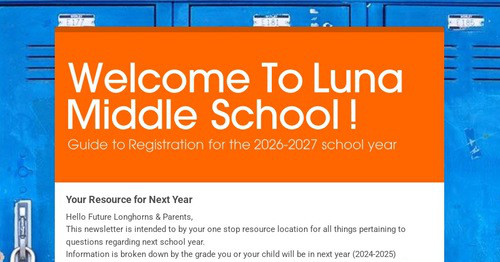
Luna Middle School Newsletter Luna Middle School Newsletter

Welcome To Luna Middle School !

Welcome To Luna Middle School !

Welcome To Luna Middle School ! - Guide to Registration for the 2024-2025 school year by Amanda King | This newsletter was created with Smore, an online tool for creating beautiful newsletters for educators, nonprofits, businesses and more

launch smore.com
NISD MAGNET PROMO 2021

View Links Below For More Info... View Links Below For More Info...

pdf
insert_drive_file
FAQ.pdf
Download
731.8 KB
pdf
insert_drive_file
Hobby Jones Zachry Trifold Magnet Flyer with NISD Facilities Map with Magnet Badges 23-24.pdf
Download
19.1 MB
pdf
insert_drive_file
Jones Magnet-Program Summary.pdf
Download
588.3 KB
pdf
insert_drive_file
Hobby-Jones-Zachry_MagnetFlyer.pdf
Download
17.7 MB
MS Magnet Schools Website
Please visit the NISD Magnet Schools Website to learn more about what they have to offer!

NISD Learner Profiles NISD Learner Profiles

Parent Needs Assessment Survey
Please help us by competing this parent needs assessment survey so that we may improve our counseling program. Thank you!

Resources Resources

NISD Online Tutoring

We would like to remind you that NISD has free Online Tutoring available at the following times:

Elementary 4:00pm-8:00pm Monday-Thursday and Saturday 10:00am-2:00pm

Middle and High School 6:00pm-10:00pm Monday-Thursday and Saturday 10:00am-2:00pm

We have NISD certified teachers ready to assist students. We focus on Core Content and language (Spanish, French, Latin and German). We also have dual language support for Elementary Students. We assist with homework, projects and prepping for exams. Our tutoring sessions are first come first serve and are one-on-one with the tutor.

Please View Flyer Below On How to Access Tutoring

zoom_out_map
NISD Threads is a clothes closet program where NISD students, PreK through 12th grade, who are in need can get clothing at no cost. All clothing is donated from families throughout the NISD community.


NISD Threads is always in need of gently used clothing items as well as new socks and underwear donations in all sizes from elementary through high school aged children and youth. You can drop off any donations at the NISD Threads Clothes Closet located at 5223 Blessing St, San Antonio, TX 78228.


If your students are in need of (gently used) clothing for the changing seasons, please contact your school counselors, Mrs. Garcia or Ms. Moore for more information.

Lieck Counselors Lieck Counselors

zoom_out_map

Monique Moore

PreK, ALE, Kinder, 1st, 2nd, and 4th Grade
denice.moore@nisd.net

210.398.1450

Twitter: @Ms_Moore_Cares

zoom_out_map

Counselors Care

We can't fix all your problems but we promise you don't have to face them alone.


Lieck Counseling Twitter: @LieckCounseling

zoom_out_map

Alicia Garcia

3rd and 5th Grade, ALE

alicia.garcia@nisd.net

210.398.1450

Twitter: @aliciaj_garcia

zoom_out_map

Helpful Links

Here are some websites you might find helpful. They include resources for discipline, student safety, school success, kid's health, and other materials you might find useful. Please call or email anytime you or your child need help.
Autism Speaks
Character Counts
Child Mind Institute
NISD Guidance and Counseling
NISD Military Families
NISD Student Tutoring
NISD Whole Child Department
Stop Bullying
Monique Zigmond
Monique is using Smore to create beautiful newsletters
Loading indicator

close

Created with

Communicate quickly and effectively with interactive newsletters.

Smore empowers educators to connect with their community, streamline school communications,
and increase engagement.

Create a newsletter