Smore logo
remove_red_eye 244
page background

The Mathematical

November 2020

TheMathematicalNovember 2020
zoom_out_map
zoom_out_map

The Distance Learning Playbook (Grades K - 12): Assessing Students

We all know there are various ways to teach our students the multitude of skills they must learn. Effective teachers employ different techniques and strategies to ensure students are engaged in meaningful learning experiences. The authors of The Distance Learning Playbook (Douglas Fisher, Nancy Frey, and John Hattie) discuss the importance of recognizing strategies that work and those that don't and adjusting as needed based on their current learners. By providing multiple strategies and opportunities to learn, teachers are increasing the impact of their teaching.


So if we constantly provide various learning opportunities, why not provide various assessing opportunities? Teachers should be evaluating student mastery throughout lessons and with varying methods. These could include exit slips, retellings or recording summaries, practice questions, application activities, etc. For more ideas on ways to assess understanding, check out the next segment.

zoom_out_map

Infusing Choice Into the Math Classroom

For many math classrooms, student choice is not usually an option. We have specific standards we need to assess and we think a written test is the best (and easiest) way to assess and see misconceptions. But this does not always provide the most accurate measurement of mastery for all students, especially those who have high test anxiety. Another option we have is to provide students a choice on how to show us what they know. (But just be careful - too many choices can be overwhelming.)


The most common way we allow choice is by having three levels for each practice set with the first level as the easiest problems (or naked math), the second level increasing difficulty by combining skills, and level three is application of the concept or word problems. Students usually must choose a certain number from each level to complete. Students seem to like this idea AND they have additional problems to work as a review if needed.


But there are more options out there for us to try:


  • Show Me - students can use pictures or make a video to demonstrate understanding

  • Tell Me - students can record verbal answers to posted questions explaining their answers using technologies like Flipgrid.

  • Digital or Paper - give students a choice in how they complete their practice problems, quiz, or test by letting them choose between a paper version or a digital option like Google Forms, GoFormative, Quizziz, etc.

  • Choose Your Own Math Adventure - students are able to work through a performance task which allows them to solve and create problems as they go

  • Math Choice Boards - students have options under each category to showcase their knowledge letting them feel like they are in command (sample template)

  • Escape Rooms - students are able to work their way through the various challenges and have to practice perseverance but have a satisfying payoff when successfully completed (more info on creating escape rooms)

For more information on these ideas, read this article.

zoom_out_map

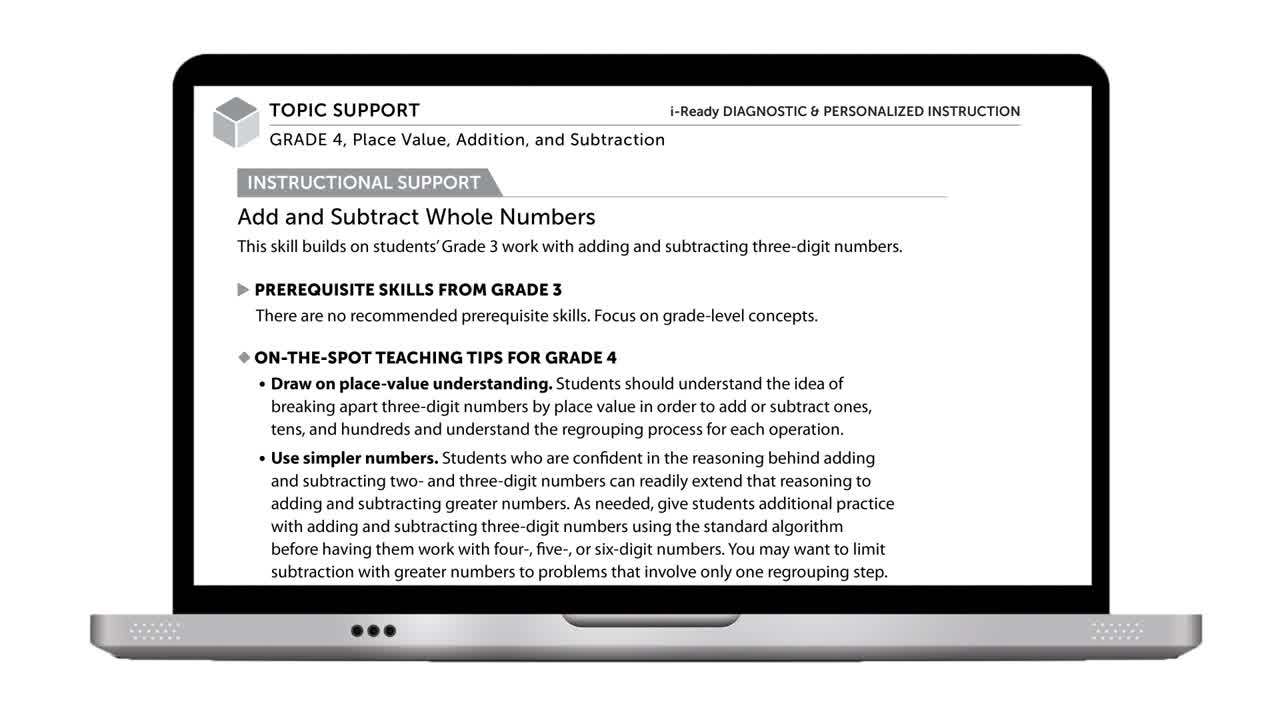
iReady - Diagnostic Reports

All-new reporting and resources in i-Ready are available to help teachers identify and address essential learning for all students so they can participate in grade-level instruction. Explore the Prerequisites report and Tools for Scaffolding Comprehension in your i-Ready accounts to get started.


How to read the Diagnostic Class Data: (Select Diagnostic Reports and click on desired class)

How to read Diagnostic Results for Individual Students: (click on student name from class)
Preparing All Students for Grade-Level Success

Preparing All Students for Grade-Level Success

See how Ready Classroom Mathematics is helping educators address unfinished learning and prepare all students for grade-level success.

launch share.vidyard.com

The Importance of Data Talks

Data talks are short 5-10 minute classroom discussions to help students develop data literacy. This pedagogical strategy is similar in structure to a number talk, but instead of numbers students are shown a data visual and asked what interests them. In a data talk the teacher does not have to be an expert in the topic of the data visualization – if a student asks a question, you can say that you do not know the answer but would love to find out, together! This a nice opportunity to model not knowing, and embracing uncertainty. Data talks are intended to pique students’ curiosity and encourage question asking, and to help them understand and “read” the data-filled world in which they live.


This is how they work. Show students a cool data visual and ask them: what do you notice? What do you wonder? What is going on in this data visualization? It is important to remember that you do not have to be an expert in the topic of the data visualization. If students ask you a question about it, you can model not knowing an answer, and being willing to find out.


Check out more information on Jo Boaler's site on Data Talks.

What's Going On in This Graph?


The New York Times provides weekly graphs, maps, and charts relevant to real-world events for students to discuss and analyze. This is another great free resource for teachers to use as a data talk to get students wondering about what they are visually seeing. The weekly graphs have questions aligned with each graph to help facilitate the discussions. Teachers can also search past graphs to find ones that are related to what they are currently teaching. Access the What's Going On in This Graph? site here.

zoom_out_map

PhET Simulations

PhET Interactive Simulations is an educational resource project at the University of Colorado where research-based simulations have been created for teaching science and math concepts. These simulations help emphasize the connections with visual models of math and science concepts for students.


PhET simulations can be used with students that are in-person and learning remotely. They can be posted in Google Classroom, slide presentations, and even Nearpod.


Check out the Math PhET Simulations.

zoom_out_map
zoom_out_map
zoom_out_map
zoom_out_map
zoom_out_map
zoom_out_map
zoom_out_map

Math Teacher Lounge

Introducing Math Teacher Lounge, a video series designed just for K–12 math educators. Your hosts Bethany Lockhart Johnson and Dan Meyer will dig deep into topics you care about and interview guests you need to know about. View the first episode below. If you would like to sign up to be notified as new episodes are posted, click here.


Episode 1 • In this episode, Bethany and Dan talk distance learning. You’ll learn a little about what’s in store for series subscribers, listen to your hosts figure out the topic du jour by playing a game, and hear from Idil Abdulkadir as the group discusses real vs. fake Zoom norms.

Math Teacher Lounge Episode 1: Welcome to MTL, let's talk distance learning!

Math Google Classrooms

Don't miss out on valuable information, helpful videos and tutorials, and professional learning registrations. Be sure to join the appropriate Math Google Classroom to ensure you have access to all the latest information. It is recommended that teachers turn on the email notification feature so that you are notified whenever a new post is made. To enable email notifications, go to Settings (when you click on the 3 horizontal lines in the top left corner), and turn on "Receive email notifications."


Join your grade-level Google Classroom to keep up with all the latest information!

Upcoming Professional Learning Upcoming Professional Learning

zoom_out_map

These Professional Learning Sessions are tentatively scheduled to be held virtually. The virtual meeting links and information will be sent out via email and Google Classroom notices prior to the meeting dates.


3-5 Collaborative PL Session

Nov 12, 2020 - Virtual, 3:15 - 4:15

All 3-5 math teachers are welcome to join this collaboration session. We will be reviewing how to use the Diagnostic Data to help drive our instruction. Meeting will start promptly at 3:15.


K-2 Collaborative PL Session

Nov 17, 2020 - Virtual, 3:15 - 4:15

All K-2 math teachers are welcome to join this collaboration session. We will be reviewing how to use the Diagnostic Data to help drive our instruction. Meeting will start promptly at 3:15


Middle School Collaborative PL Session

Nov 18, 2020 - Virtual, 4:00 - 5:00

All 6-8 math teachers are welcome to join this collaboration session. Meeting will start promptly at 4:00.


High School Collaborative PL Session

Dec 2, 2020 - Virtual, 4:00 - 5:00

All high school math teachers are welcome to join this collaboration session. Meeting will start promptly at 4:00.

Webinars & Recordings

#OpenUpMath Twitter Chat

Join us for a great half-hour of learning via Twitter each Monday night at 8:30 PM Eastern. First-time participant? Check out this how-to video.


  • November 2nd – Purposeful Questioning
  • November 9th – Facilitating Student Discourse
  • November 16th – Progression of Learning
  • November 23rd –Thankful for Tech Tools
  • November 30th – November Reflections


Want to catch up on prior chats? Check out the archive!


Manipulative Mondays

Register for one or more of these FREE webinar series of Manipulative Mondays. These are hands-on, interactive webinars that allow teachers to deepen their understanding of the CRA model (concrete-representational-abstract), try out manipulatives in a virtual environment, and build confidence in mathematical thinking. Register for any of the sessions listed below. All sessions begin at 4:00 and include prizes.


Pattern Blocks K - 2, Nov 2

Pattern Blocks 3 - 8, Nov 9


Exploring the Potential of Computational Thinking: Contexts and Career Opportunities

2-Part Series

Computational-thinking skills include seeing patterns, creating rules or algorithms, making abstractions, and decomposing a mathematical structure into component parts. These skills are closely tied to many applications of mathematics as well as to the Standards for Mathematical Practice. Whether during in-person instruction or remote learning, teachers and students must continue to develop the mathematical practices; computational thinking provides an engaging context for this work. Students will explore engaging mathematical problems, develop the practices, and build foundation skills for careers which require computational thinking.


Part 1, Nov 10, 2020 at 4:00: The session will explore contexts in which computational thinking is likely to occur and highlight career pathways where students might use these skills. The session will consider both face-to-face and virtual settings for instruction.

Register here.


Part 2, Dec 8, 2020 at 4:00: The session will look at computational-thinking tasks from the perspective of the practices, in both face-to-face and virtual settings for instruction. How do we help students decontextualize their thinking in order to develop abstractions? How do we support students to see structure and make use of repeated reasoning to create algorithms?

Register here.


Mini-Workshops for Elementary, Middle, and High

These mini-workshops are available for teachers to attend at their own convenience with immediate access upon registration. The sessions are available for 16 weeks after signing up and are approximately 2 to 3 professional development hours. Each mini-workshop is reduced to $39 per session. Here are some of the topics:


  • How to Build Confidence with Elementary Math
  • How to Engage Students in Live Distance Learning
  • How to Make Math More Like Video Games
  • How to Use an Open Middle Problem
  • How to Use Clothesline Math
  • How to Use Desmos Activity Builder
  • How to Use Math Flips to Build Fluency
  • How to Use Would You Rather Math


Upcoming sessions:


  • How to Use Art to Teach Culturally Relevant Algebra
  • How to Use Mathematical Openers


For more information and to register, use this link.


GCA Webinar Series

These three webinars focus on topics designed to help our teachers get the most out of our GCA platform. These sessions are free and include information on helping teachers build instructional activities, provide effective student feedback, and provide a better understanding of how to analyze the data gained from GCA. Sign up today!


Analyzing Data

Nov 11, 2020, 10:00

Register here.


Number Talks with Fractions: Building Fluency & Numerical Reasoning (5th - 8th grade)

Nov 2, 2020 - 5:00 to 7:00

Sherry Parrish will lead professional learning to support teachers in learning how to facilitate virtual and face-to-face number talks, a 5 to 15-minute classroom routine to help students develop numerical reasoning and mental math computation strategies with fractions. Participants will engage in virtual number talks, analyze classroom video clips, and learn how to connect student strategies to the Georgia Standards of Excellence and the Standards for Mathematical Practice.

Cost: $70, Register here (Deadline: Oct 18, 2020)


Great Adventures in Mathematics

This webinar series features 4 sessions helping teachers understand the progression of math foundational skills such as number lines, how arithmetic leads to algebra, and relationships between multiplying and dividing with linear algebra. These sessions teach about on-grade material that is infused with "just in time" prerequisites and how prior knowledge from previous grades is essential. Click the links below to watch the different sessions. All the resources discussed are linked to our Ready Mathematics Curriculum.


The Arc of Arithmetic to Algebra

Number Lines 101: The Fundamentals

Number LInes 102: Fraction Computation

Moving Beyond Cross-Multiply-and-Divide


Session Handouts and Resources


Developing, Maintaining, and Extending Fluency in Math

Fluency in mathematics means more than fast and accurate recall of facts. Yes, students must know their facts from memory, but learning them by memorization is not helpful. Knowing from memory means learning from deliberately sequenced, strategy-based instruction. Knowing from memory means shorter periods of practice over a longer period of time. Being fluent means moving beyond basic facts to using that same reasoning with larger whole numbers, fractions, and decimals.


How do we support this for our students? Watch the two-part series that benefits kindergarten to middle grades teachers.


Part 1: Addition and Subtraction

Part 2: Multiplication and Division

zoom_out_map

Request a Visit or Meeting

As you continue to reach towards achieving your goals, please utilize me as a resource. I would love to spend time with teachers and admin during your planning or instructional periods. If interested in a meeting, a class visit, or modeling, please complete this form to request a time. You can also send me an email anytime!
zoom_out_map

Comments, Questions, or Concerns?

Please contact Michelle Clarke, Math Content Specialist, with any comments, questions or concerns.

Email: michelle.clarke@cowetaschools.net
Website: curriculum.cowetaschools.org
Location: 167 Werz Industrial Boulevard, Newnan, GA, 30263
Phone: 770.254.2800
Twitter: @clarkemath

Loading indicator

close

Created with

Communicate quickly and effectively with interactive newsletters.

Smore empowers educators to connect with their community, streamline school communications,
and increase engagement.

Create a newsletter