


Improving Assessment Practices with English Learners
Test anxiety is real for many students. Now imagine that you have to manage your test anxiety in a language different than your native language? While many students make early growth in social English language once enrolling in a U.S. school, academic English takes 5-7 years on average to develop to a level in which students are able to participate in content area work without EL supports. Even after exiting English Learner programs, students who have a native language other than English are still culturally and linguistically diverse people. This means that when it comes to assessing diverse students, we should always consider what barriers might be in place that could prevent students from showing us what they really know and are able to do in the content areas.
In this newsletter, we discuss some considerations when it comes to support of English learners in assessment situations. We refer to the ELPA (English Language Proficiency Assessment) which is the state of Iowa's approved language assessment. If you would like to learn more about the ELPA, you can access information both on the State of Iowa ELPA Page, as well as the official ELPA21 Consortium website.

Allowable Accommodations for Students Receiving English Language Supports
Why are accommodations important for English Learners?
Accommodations are intended to level the playing field for students who are not yet proficient in academic English. Some examples of allowable accommodations for English learners include extra time to take a test, use of a Word-to-Word dictionary, options to take a test in a quieter room away from distractions, or the use of scratch paper to write out answers before entering answers on a computer-based test.
All accommodations are intended to help gather the best possible measure of what students really know and are able to do, so it's important to use accommodations IF the student wants to use them. Having a student use an accommodation when they don't want it or when it is not really needed for their level of ability can actually have a detrimental impact and affect the ability to gather accurate measures of student ability.
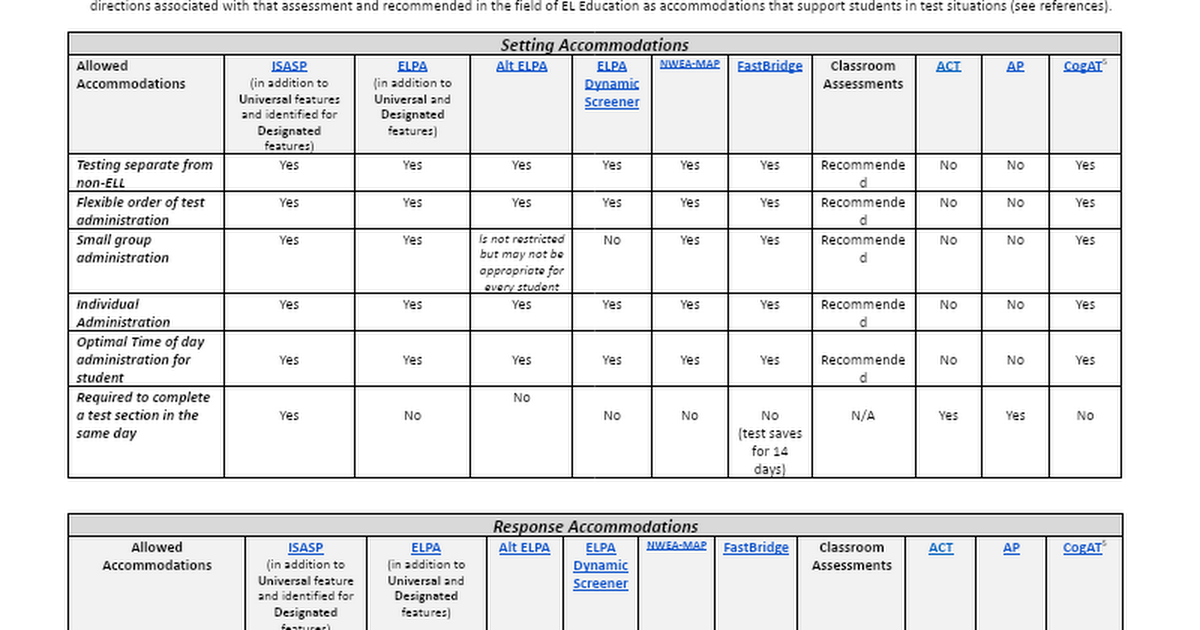
Many types of assessments have information on what accommodations are allowable for English Learners for that particular assessment. The document below shows some common assessments used in Iowa, and a summary of the allowable accommodations allowed in each type of assessment. Please NOTE: It is not sufficient to only refer to the summary. Instead, educators should open the link to each assessment's accompanying accommodations manual, which is linked to the name of the assessment in each column.

Test Preparation for English Learners
Explain the Test Objectives and Outcomes:
The goal of English language proficiency assessments such as the ELPA, is to measure a student's academic English language proficiency. Often, students may not understand that they are being evaluated not only on the accuracy of WHAT they are saying, but also the WAY in which they are saying it. In other words, are they using academic English language?
To help students acquire a better understanding of what academic English is, talk about how we speak and write for different purposes in different environments. For example, the way we speak during class discussions is usually different than we might speak when giving a presentation to a group. Speech used in a presentation is more formal, and is a good example of the language we want to demonstrate on an English language assessment, such as the ELPA.
Encourage students to write down what they want to say or write on scratch paper and then read/re-write what they wrote on the Speaking test, or Writing test. While educators cannot proof, comment, or edit what students write in advance of answering a question, the act of students preparing and proofing their own responses will help decrease some anxiety and also give students the opportunity to review and edit their own responses.
Setting Goals:
Students need to know where they are and where they are going, and this is no less important when it comes to test scores. On the ELPA, students receive a score between 1-5 in each language domain of Reading, Writing, Listening, and Speaking, but a single digit number does not tell a student why they received that score and what they need to do to improve.
Connect the domain score for students to the ELPA Achievement Level Descriptors that describe the skills that students typically demonstrate within each proficiency level. This helps both educators and students know both where they are currently functioning in academic English skills, and also what skills need to yet develop to move to the next level of proficiency. You can access the Achievement Level Descriptors on the Iowa DE website.
Help Students Own the Test Environment:
Iowa has moved to using computer-based tests for many state required tests. As testing environments change over time, it is important to help students anticipate different test formats and settings. Make sure that your English Learners are comfortable using the kind of device (computer or other device) they will be tested on and know how to navigate online assessments. Take advantage of practice tests offered by each assessment and coach students through practice tests so they understand how questions are asked and options they may have in the ways they answer. It’s also important that students have been exposed to the different item types they will see on assessments, and go into test day understanding what different kinds of questions are being asked of them. This includes knowing about selecting or constructing responses on a test as well as how to save answers.


