
September DEI Newsletter
ACNL | 2024
The Political Action Edition: The September DEI Committee Newsletter
Welcome to the September edition of our DEI newsletter! This month, we’re focusing on a powerful and timely theme: Political Action and Activism. In healthcare, the importance of political engagement cannot be overstated. As nurse leaders, we are uniquely positioned to advocate for policies that impact the health and well-being of our communities, address health disparities, and advance equitable care for all.
Political activism is not just about influencing laws—it’s about using our collective voice to drive change, hold decision-makers accountable, and promote inclusivity in healthcare settings. Whether advocating for health equity, participating in grassroots movements, or shaping policies at local, state, and national levels, our leadership is essential.
In this edition, we’ll explore how nurse leaders can harness their expertise and passion to make a difference, provide examples of successful advocacy efforts, and offer strategies to get involved. Let’s continue to push for a more just and equitable healthcare system—because our communities and our patients depend on it.
The DEI Committee Members:
Anitra Williams
Christina M. Oldini
Kimberly Long
Karen Mitchell-Keels
Make'da Traynum
Marshall Blue
Nicole Barnett
Sharon Goldfarb
Sheree Criner
Yury Nevarez
Newsletter produced by Vanessa Kerr and Sharon Goldfarb.

SageJournals: Nursing Professional Organizations: What Are They Doing to Engage Nurses in Health Policy?
Abstract
Nurses have great potential to contribute to the development of health policy through political action. We undertook a systematic website review of international- and national-level professional nursing organizations to determine how they engaged registered nurses in health policy activities, including policy priority setting, policy goals and objectives, policy products, and mechanisms for engaging nurses in policy issues. We reviewed 38 organizations for eligibility and 15 organization websites met our inclusion criteria. Six professional nursing organizations had comprehensive websites with a discussion of specific policy goals and objectives, policy-related products and mechanisms for nurses to become engaged. Future research is needed to evaluate how nursing professional organizations establish policy priorities and to evaluate the effectiveness of the strategies used to politically engage nurses.
Read more here.


How Nurses’ can Impact Social Determinants of Health and Health Outcomes by Voting
Introduction
Americans, as members of a democratic society, have the right to vote guaranteed by our constitution. We also have the responsibility to vote so that our individual and collective voices are heard. Indeed, voting is one of the essential ways that Americans create the society in which we want to live with our friends, families, and neighbors.
Nurses are in the unique position of being able to influence health outcomes. Whether we are caring for the very young or the very old, whether we care for one patient, one family or one community, we are promoting the best health, preventing disease, mitigating the symptoms of illness and easing the transition into life and into death. Nurses are also key health policy advocates. Nurses can identify health disparities, address social determinants of health, and impact health outcomes by voting for key legislative issues and educating our constituents. This article seeks to link the importance of nurses’ advocacy efforts to health outcomes for health equity and sound public health, both for obvious health care legislation and for legislation that may impact public health and wellness.
The Role of Nurses in Political Activism
Why Nurses Should Be Politically Active
Nurses should be politically active for several compelling reasons, all of which relate to their unique role in the healthcare system, their impact on patient care, and their ability to influence healthcare policy for the better. Here are some key reasons:
Advocating for Patients
Frontline Experience: Nurses are on the frontlines of healthcare and have direct insight into the needs, challenges, and experiences of patients. Their perspective is crucial in shaping policies that truly address patient needs and improve healthcare outcomes.
Patient Advocacy: Nurses are often the voice for vulnerable populations, including those who may not be able to advocate for themselves. By engaging in political activities, nurses can work to ensure that healthcare policies are equitable and accessible to all.
Influencing Healthcare Policy
Shaping Policies: Nurses bring a practical, evidence-based perspective to policy discussions. Their involvement ensures that healthcare policies are grounded in the realities of clinical practice, leading to more effective and implementable solutions.
Preventing Unintended Consequences: Without input from nurses, healthcare policies may be developed by individuals who lack clinical experience, leading to well-intended but potentially harmful decisions. Nurses can help prevent these unintended consequences by contributing their expertise.
Improving Working Conditions
Advocating for Safe Staffing: One of the critical issues in nursing is safe staffing. Political advocacy has been instrumental in proposing and passing legislation [in California] that mandates safe staffing levels, which directly impacts patient safety and nurse well-being. Dierkes et al. (2022), in their longitudinal study of California compared to other states, posit that “state legislators deliberating staffing mandates should consider a protective factor such policies provide during economic recessions and the implications for the quality and safety of care” (p. 1).
Securing Fair Compensation and Benefits: Political engagement can lead to better compensation, benefits, and working conditions for nurses, helping to address issues like burnout and high turnover rates in the profession.
Addressing Broader Social Determinants of Health
Impacting Public Health: Nurses understand that factors like poverty, education, and access to healthcare significantly influence health outcomes. Political activism allows nurses to advocate for policies that address these social determinants of health, leading to healthier communities.
Championing Public Health Initiatives: Nurses can influence public health policies, such as vaccination programs, environmental health regulations, and health education, which have widespread implications for community health.
Advancing the Profession
Leadership Opportunities: Political activism provides nurses with opportunities to take on leadership roles within their communities, professional organizations, and the government. These roles can help advance the nursing profession and improve its standing in society.
Shaping Future Healthcare Delivery: By participating in policy development, nurses can help shape the future of healthcare delivery, ensuring that it remains patient-centered, equitable, and sustainable.
Promoting Ethical Standards
Ethical Advocacy: Nurses are bound by the American Nurses Association (ANA) Code of Ethics for Nurses that emphasizes advocacy for patient rights and social justice. Political activity is a natural extension of this ethical commitment, allowing nurses to advocate for policies that reflect these values.
Addressing Inequities: Nurses can work to address inequities in healthcare access and outcomes, advocating for policies that promote fairness and justice in the healthcare system.
Responding to Emerging Issues
Adaptation to Change: The healthcare landscape is constantly evolving, with new challenges such as pandemics, technological advancements, and changes in healthcare laws. Nurses need to be politically active to ensure that the profession can adapt to and address these emerging issues effectively.
Global Health Impact: Political engagement is not limited to local or national issues; nurses can also influence global health policies, contributing to international efforts to improve health and well-being worldwide.
Political activism is not just an option for nurses; it is a responsibility that comes with their role as healthcare providers and patient advocates. By being politically active, nurses can ensure that their voices are heard, their expertise is utilized, and their patients' needs are met through effective, evidence-based healthcare policies.
Historical Perspective
Historically, nurses have been active in politics, particularly in the fight for women's suffrage and broader social reforms. In 1917, a group of nurses joined the protests in front of the White House, advocating for women's right to vote (Puglionesi, 2020). They believed that gaining the right to vote would enable them to influence public health policies, improve workplace standards, secure funding for hospitals, and enhance the lives of working-class and poor individuals who were most affected by illness.
The suffragist movement, predominantly led by white, middle- and upper-class women, often excluded Black women, who had to fight for their rights within separate organizations. For Black nurses, this exclusion was doubled; they had to battle not only for their rights as women but also for recognition within a profession that often mirrored the racist structures of the broader society (Puglionesi, 2020).
Lavinia Dock was a notable nurse and suffragist. In June 1917, Dock, was arrested while protesting for women's suffrage outside the White House. As co-founder of the International Council of Nurses and the American Nurses Association, Dock was already well-established. Despite her professional achievements, she chose to work at the Henry Street Settlement in New York City, caring for the under-resourced community and where she became deeply involved in public health and social reform efforts. Her care and concern for her patients as a nurse made it clear she needed to work for policy (Puglionesi, 2020).
Another influential figure in nursing and suffrage was Sarah Tarleton Colvin. Colvin's experiences as a nurse exposed her to the harsh realities of gender-based power dynamics in the workplace. Nursing students, like Colvin, were often exploited as unpaid labor, and this exploitation fueled her desire for broader social reforms.
Colvin, was drawn into the suffrage movement through her dissatisfaction with the status quo in both public health and politics. She served as the president of the Minnesota Nurses Association, where she became increasingly frustrated with male politicians' indifference to public health issues. Her opposition to World War I and her involvement in suffrage protests exemplified her commitment to social justice. She believed that true freedom required not just the right to vote but also economic rights, fair wages, affordable housing, and universal public health care (Puglionesi, 2020).
The work of nurses like Dock, Colvin, and others, laid the groundwork for future generations of nurse activists. Their struggles for suffrage were about challenging the broader social injustices that affected their profession and the communities they served. Today, the legacy of these nurse activists is evident as nurses continue to fight for the rights of their patients and themselves. We know there is an ongoing need for political activism in the nursing profession.
Current Trends
There are many notable political nursing leaders who have made significant contributions in the intersection of healthcare and policy. While many nurses do may things to get politically involved some nurses to watch include:
Lauren Underwood (U.S. Congresswoman)
Ms. Underwood is the U.S. Representative for Illinois's 14th Congressional District. She is a registered nurse and a public health expert who became the youngest Black woman to serve in Congress when she was elected in 2018. She has been a strong advocate for healthcare reform, maternal health, and improving access to affordable healthcare. Ms. Underwood has focused on policies that improve the quality of care for veterans, support maternal health, and expand access to healthcare through the Affordable Care Act (ACA). She co-founded the Black Maternal Health Caucus in Congress, which aims to address disparities in maternal health outcomes.
Mary Wakefield
Dr. Wakefield is a former Acting Deputy Secretary of the U.S. Department of Health and Human Services (HHS). She is a registered nurse and healthcare administrator who served as the Acting Deputy Secretary of HHS during the Obama administration. She has a long history of working in healthcare policy, with a focus on rural healthcare. Dr. Wakefield played a key role in implementing the ACA and has been involved in numerous initiatives aimed at improving healthcare delivery in rural and underserved communities.
Bonnie Castillo
Ms. Castillo is a registered nurse and as the Executive Director of National Nurses United (NNU). She leads the largest union of registered nurses in the United States. She has been a vocal advocate for nurses' rights, safe staffing ratios, and Medicare for All. Ms. Castillo has led numerous campaigns advocating for better working conditions for nurses, the protection of public health, and the implementation of single-payer healthcare. She has been a prominent voice during the COVID-19 pandemic, advocating for the safety and well-being of frontline healthcare workers.
Elizabeth McGlynn
Dr. McGlynn is the Vice President for Kaiser Permanente Research. Elizabeth McGlynn is a nurse with a significant background in healthcare policy and research. She has been involved in shaping health policy at the federal level and has contributed to research that influences healthcare practices and policies. Dr. McGlynn's work has focused on improving healthcare quality and patient safety through research. Her efforts have contributed to policy development aimed at enhancing the effectiveness of healthcare delivery.
Jennifer Mensik Kennedy
Dr. Mensik Kennedy brings more than 25 years of nursing experience to the ANA presidency and has devoted more than a decade of service to ANA, providing leadership in high-profile positions such as ANA Committee Treasurer and service on ANA’s Board of Directors while maintaining membership with the Oregon Nurses Association. Dr. Mensik Kennedy continues to address some of the most pressing issues facing nurses: racism in nursing, the health and well-being of nurses, full practice authority for advanced practice registered nurses (APRNs), and nurse staffing.
These nurse political leaders, demonstrate the critical role that nurses play in shaping public policy and advocating for improvements in the healthcare system. Their work highlights the importance of having experienced healthcare professionals involved in policymaking to ensure that the needs of patients and healthcare workers are adequately represented.
Voting as a Social Determinant of Health
Definition of Social Determinants of Health (SDOH)
The Future of Nursing 2020-2030: Charting the Path to Achieve Health Equity, one of three Future of Nursing Reports published by the National Academies of Medicine, identified nurses as key stakeholders in achieving health equity in the U.S. and globally while it advanced the call for nurses to improve health care for people, families, and communities around the world (Knighten, 2023). An expanding body of research demonstrates the relationship between social determinants of health, inequity in health and health care, and the health status of individuals and populations. (FON, 2021). The report defines SDOH as “the conditions in the environments in which people live, learn, work, play, worship, and age that affect a wide range of health, functioning, and quality-of-life outcomes and risks” (FON, 2021, p. 32). Many variables impact persons of color (POC), and those living in the rural U.S. causing them to experience a considerably greater disease burden and lower life expectancy compared to their higher income, White, and urban counterparts, and this gap has been growing ever greater (Escarce, 2019 cited in FON, 2021).
Political Determinants of Health
Daniel E. Dawes, author of Political Determinants of Health (2020) takes us farther back to the root causes of social determinants of health. He posits that political determinants of health create social drivers that influence all elements of health. These include inadequate environmental conditions, lack of access to transportation, unsafe neighborhoods, and insufficient healthy food options and food insecurity. By understanding these determinants, their root causes, and their impact on the equitable distribution of opportunities and resources, we as nurses can be better able to develop and implement practical solutions to close the health gap.
The premise of Dawes’ conceptual framework is that 1) structural determinants of health arise from upstream health policy decisions that are “causes” of the social determinants of health, 2) social determinants of health are the “causes” of poor health, and 3) health-related social needs are the “effects” of the “causes” and he states “Voting is arguably the most important aspect of the political determinants of health.” (vot-er.org, 2024).
Connection Between Voting and Health
Currently there are about 72 million Americans who are not registered to vote. Largely, this is because no one has asked or encouraged them to vote. This means decisions about health policy are determined by those who do vote, and that leaves many Americans without a voice to determine how health policies impact them. There are nearly 5 million nurses nationwide, and there is power in our voice; however, according to Vot-ER, 2024) registered nurses, physician assistants, dentists, pharmacists and physicians are 12-23% less likely to vote than the general population. We can be role models here, folks.
When you examine the top three groups of people who disproportionately make up those 72 million unregistered voters, they’re people who are young, low-income, and people of color. It’s these same three groups who are currently marginalized by our healthcare system and lack access because of their SDOH. What if these patients were educated and helped to register to vote? How would this begin to transform their health care experience and our society? (vot-er.org, 2024).
It is imperative that the voice of nurses be heard during the decision-making processes our government agencies engage in, such as the Centers for Medicare and Medicaid Services (CMS), Centers of Disease Control (CDC), The Federal Drug Administration (FDA), and Health Resources and Services Administration (HRSA). This has a huge impact on the health care system, providers, clinicians, and the patients who receive care.
There is relationship between voter participation and community health outcomes. A recent case study where nurses demonstrated leadership to influence votes in congress resulted in better access for patients, reducing disparities related to payor.
During the 2021-2022 legislative session, the Association of California Nurse Leaders (ACNL) members leadership supported AB848: Continuous Glucose Monitoring (CGM) which enabled medically eligible diabetic patients to obtain a CGM under Medi-Cal benefits and supported securing an exemption from AB97 which avoided provider cuts for CGMs in the State Budget. All other payors already had approved medical eligibility, so now diabetic patients with Medi-Cal achieved parity. As described by the National league for Nursing (NLN) “when nurses speak, health care changes for the better” (NLN, 2024).
Strategies for Nurses to Encourage Voting
Most people are unaware of the policymaking process, so it is important for us to use social media and other means to educate our communities about the process and the policies (Morris, 2023).
Educating Patients
It is important for nurses to inform patients about voting. Reminding them about the issues on the ballot that concern consumers of health care helps them to recognize the impact to them personally. It also helps them to understand the issues, which can be confusing when bound with legal language. Our role is not to align them with a particular party or partisan initiative, but instead to remind them that their voice matters and will impact the outcome of the legislation, and their healthcare and outcomes.
Engaging Colleagues
Workplace initiatives exist in some areas that encourage voter registration. Hospitals who are members of the state hospital association generally have legislative liaisons who can produce reports and summaries of legislation to help employees understand how legislation can impact hospitals, healthcare systems and patient care. Creating a culture of civic engagement within healthcare settings can result in a sense of pride when employees are involved in decision-making.
Collaborating with Organizations
Opportunities abound for nurses to partnering with local, regional, and national organizations to promote voter registration and participation. Professional organizations, such as the American Nurses Association\California (ANA\C) have lobby days, Advocacy Institute, resources to help educate members. They have a link to the state voter website and a toll-free number if you have questions: 1-800-345-VOTE. They remind us that every registered voter gets a ballot by mail. Early voting begins 29 days prior to the primary and general election and ends the day before the election (varies by county).
Conclusion
The Association of California Nurse Leaders (ACNL) Health Policy Committee believes it is essential for nurse leaders to “Become informed to intelligently engage.” We must be aware of legislation affecting our state, communities, patients, and nurses; be educated and educate others; and be supported to take action on key issues. We hope this article acts as a call to action for nurses to 1) register to vote and then actually vote, 2) educate colleagues and their communities on the importance of having their voice heard, and 3) consider how voting can be a tool for achieving health equity and better health outcomes.
Resources
California Online Voter Registration
By Mary Lynne Knighten & Sharon Goldfarb
References
Dawes, D. E. (2020). The political determinants of health. Johns Hopkins University Press.
Dierkes, A, Do, D., Morin, H., Rochman, M., Sloane, D., & McHugh, M. (2022). The impact of California’s staffing mandate and the economic recession on registered nurse staffing levels: A longitudinal analysis. Nurs Outlook, 70(2): 219–227. http://doi.org/10.1016/j.outlook.2021.09.007
Knighten, M. L. (2023). Competency-based nursing education and the future of nursing: Where the faith community nurse fits in. International Journal of Faith Community Nursing, 8(1), Article 6. https://digitalcommons.wku.edu/ijfcn/vol8/iss1/6
Morris, G. (2023, November 11). 10 ways nurses can get involved in policy. https://nursejournal.org/articles/ways-nurses-can-get-involved-in-policy/
National Academies of Sciences, Engineering, and Medicine. 2021. The Future of Nursing 2020-2030: Charting a Path to Achieve Health Equity. Washington, DC: The National Academies Press. https://doi.org/10.17226/25982
Puglionesi, A, (2020, July 14) Nurses have a history of activism in the U.S., championing suffrage and health care access. https://www.teenvogue.com/story/history-activist-nurses-united-states
Vot-ER Presentation Deck (2024). https://docs.google.com/presentation/d/13xHpyVY9VodnKy9uBgOmsvVpO5T7Ybib_vwtTa2f9bU/edit?usp=sharing

From Nursing Politics: Nursing is Political!
Nursing is political!
AONL and ACNL have several initiatives to help members stay informed about the legislative
landscape and to train nurse leaders to be effective advocates. This committee’s hard work
advocating for equity and challenging bias is fostering a culture that promotes equitable care
delivery.
As nurses do this important advocacy work, we cannot ignore the importance of political
engagement. Advocacy and politics are clearly related, but there are important differences.
Think of it like cargo being delivered on a train: Advocacy is the cargo – those policies we work
for, wrapped in the data and rationale to support those policies. Politics is the train that cargo
travels on to the destination – passage of laws and implementation of policy. It is important to
develop policy but there are plenty of great ideas spelled out in white papers and proposals that
are never enacted and never help solve the problem they are intended to address. (Conversely,
bad policies are sometimes passed by lawmakers with limited knowledge of the topic at hand.)
One might argue that in nursing, we’ve gotten good at the cargo, but have sometimes shied
away from the train tracks. And we certainly have shied away from driving the train.
It is time to change this. Nursing is political. And for those who find “politics” - whatever that
means to them – distasteful – we need to refine the way we think about politics. Politics is
simply our form of governance: “this government of the people, by the people, for the people.”
Politics and the action of the officials we elect impact not only the industry we work in, and the
care also we provide, but all the social determinants of health from education to food policy. If
one defines health broadly, the list of health-related topics addressed by our elected officials is
long: immigration, climate change, gun safety. If you care about any of these, you care about
politics.
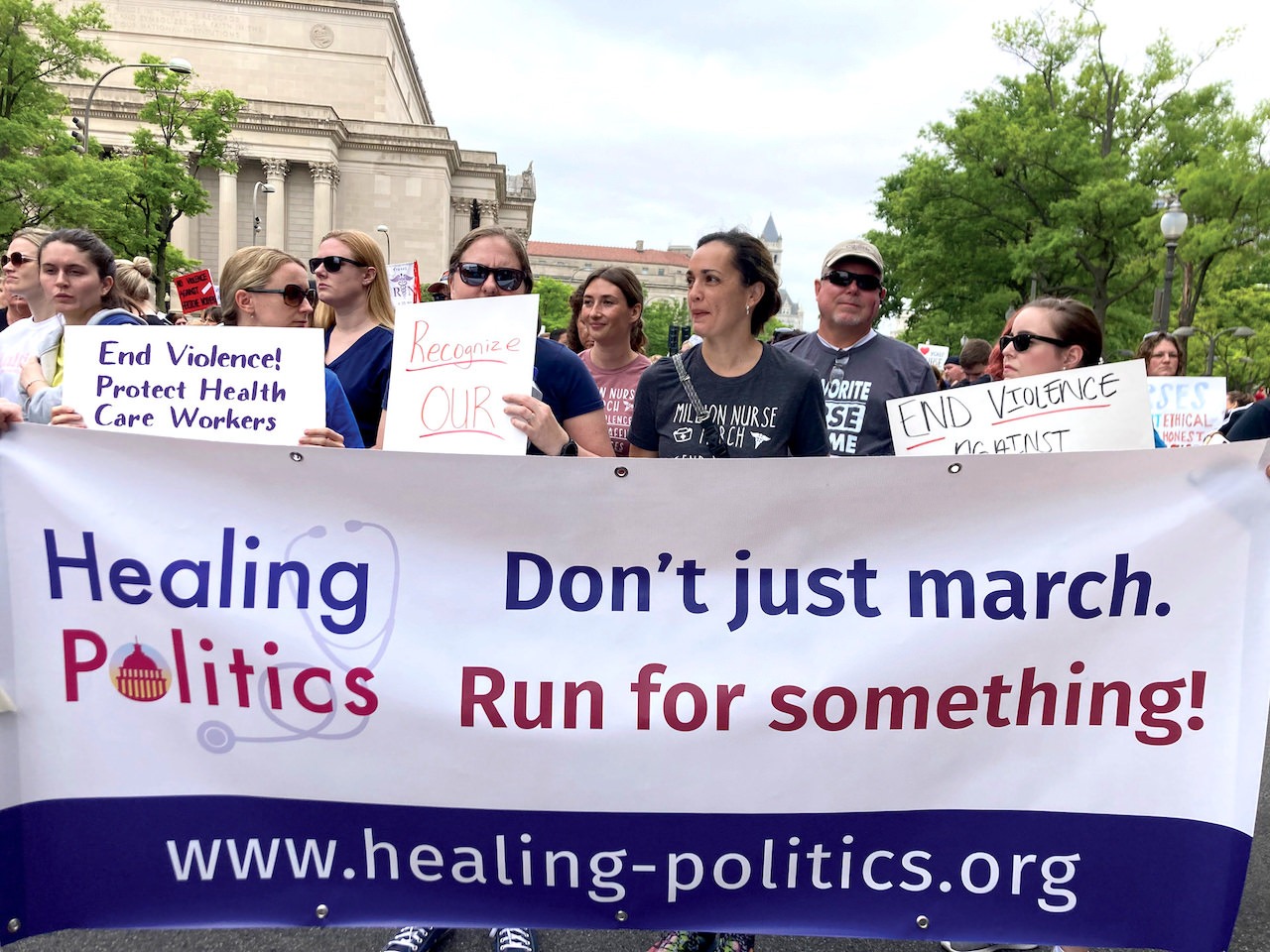
Healing Politics is a 501c3 nonprofit nonpartisan organization that seeks to educate nurses
about the importance of political engagement and provide practical training about all aspects of
civic engagement – from the importance of voting to running for elected office.
This month, the online educational event addresses the important topic of political
determinants of health (PDOH). As nurses, we’re keenly aware of the social determinants of
health (SDOH) - those conditions in the environments where people are born, live, learn, work,
play, worship, and age that affect our health. Perhaps more important are the political
determinants of health – the policy choices that led to the SDOH.
Join Healing Politics on September 23rd from 5-6p Pacific/8-9p Eastern to learn more about
PDOH from Nelson J. Dunlap, JD, VP, Public Policy & External Affairs, School of Global Health at
Meharry Medical College. Registration is here.
This election season is a call to action!
- Understand the importance of politics and the PDOH.
- Be sure you are registered to vote and make a plan to vote. Check out NursesVote for resources.
- Get a Vot-ER badge and encourage family, friends, co-workers and patients to register and vote. Join the efforts at NursetheVote.
- Learn which candidates support policies most in line with your values and priorities and volunteer to help them get elected.
Yes, nurses are trusted. It is time to leverage that trust! When the voice of nursing is
loud and strong, health care policy changes for the better. Make your voice heard!
By Lisa Summers, Co-Founder and President of Healing Politics
Previous Newsletters
August: Community Health Nursing
July: Advocating for Patient Summer Safety
June: Pride Month
May: Mental Health Awareness Month
April: Disability Rights
March: Women's Health Equity
February: Environmental Health and Justice
January: Combatting Misinformation and Disinformation
December: Resilience and Community Care
November: Navigating the Digital Frontier
October: Legislative Update
September: Maternity Care
August: Civic Health Month


Association of California Nurse Leaders
Email: info@acnl.org
Website: https://www.acnl.org/
Location: 180 Promenade Circle suite 300, Sacramento, CA 95834, USA
Phone: 916-779-6949