
Smore logo
remove_red_eye 333
page background

Accountable For everyone's Learning

Establishing Positive Growth Mindset Culture in Mathematics

Accountable Foreveryone's LearningEstablishing Positive Growth Mindset Culture in Mathematics

key terms:


growth mindset, culture, communicate, collaborate, creative, student engagement, accountable talk, technology, integration, accountable for all learners

zoom_out_map

Castlebridge Public School Peel District School Board

zoom_out_map

Collaborating Teachers


Sarah Sommers Grade 5


Kristyn St. Onge Grade 5


David Markus Grade 4


Sumita Paul Grade 3

Critical Inquiry

Through the inquiry process teachers have discussed student work and student needs to determine GAPS in numeracy. The findings indicated a need for engaging students in Critical Inquiries, Accountable Talk, and Consolidation Strategies in Mathematics.

Greatest areas of need were in students’ articulation of their thinking and comprehension of information received either from text or from auditory lessons, keeping in mind ELL and Special Needs learners. Instructional strategies were reviewed and teacher reflection indicated a need for explicit instruction of accountable talk (talk moves), consolidation strategies (gallery walk, math congress, talk moves, accountable talk) and critical inquiry thinking tools as outlined in the Critical Consortium (TC2) teachings. By providing students with rich, problem solving tasks that are responsive to the culture and learning styles of individual students and explicit instruction we anticipate greater engagement and ‘math talk’, marked increase in students ability to make their thinking visible and growth in mathematics levels.

Theory of Action

Grade 3: If students are provided rich tasks with opportunities to engage in accountable talk then they will be better able to communicate their mathematical thinking.


Grade 4: If students question their mathematical thinking in collaborative inquiries, then they will be able to better understand and communicate the relevant uses of the mathematical process and how it relates to everyday problems.


Grade 5: If students are provided rich tasks with opportunities to engage in positive, accountable talk then they will be better able to communicate their mathematical thinking.

Growth Mindset (Dr. Carol Dweck) and Positive Norms ( Dr. Jo Boaler)

All of the grades had similar focuses on their inquiries:


1. Communication

2. Accountable Talk

3. Thinking Critically


A lot of the foundational theory driving all three inquiries came from the work of Carol Dweck and Jo Boaler. In an early staff meeting we were privy to a youtube video entitled The Power of Belief by Eduardo Briceno on Growth Mindset which outlined the difference between growth mindset and fixed mindset.


Fixed Mindset: Individuals in a fixed mindset believe you either are or aren’t good at something, based on your inherent nature, and your abilities, intelligence and talents are fixed traits.

Growth Mindset: While individuals in a growth mindset believe anyone can be good at anything, because your abilities are entirely due to your actions and can grow overtime.


This thinking led us to ponder how will we help students develop a growth mindset in our classrooms? This is where Jo Boalers` work around delivering positive key messages in the math class proved to be an excellent resource for establishing a culture of safe dialogue and a willingness to learn from mistakes.


Seven Positive Norms for the Math Class

1. everyone can learn math to the highest level

2. mistakes are valuable

3. questions are really important

4. math is abut creativity and making sense

5. math about connections and communicating

6. math class is about learning not performing

7. depth is more important than speed


Armed with this sound pedagogical research and theory around good education we began to delve into how to create classrooms that fostered accountable talk, communication, critical thinking in positive environments that allowed students to grow and achieve to their highest potential.

zoom_out_map

Mindset

By Dr. Carol S. Dweck
zoom_out_map

The Elephant in the Classroom

By. Dr. Jo Boaler
Carol Dweck - A Study on Praise and Mindsets
According to Resnick (2006) a educational psychologist, “Cognitive psychology suggests that when you explain things you learn them, when you explain to yourself why some statement in a textbook is probably true, you come to understand it, you come to learn it. You process it more deeply, you remember it for longer, you can use it for more things. It pays to press students to self-explain because they process what they're learning more deeply and they can then transfer it.”

Grade 5 Grade 5

Using Technology and Problem Solving Together: The beginning

This task was done before the Grade 5 teachers took the students on an enlightening journey of creating Positive Norms in the classroom. In this Educreations the Grade 5 students were working together to solve problems with place value. The students enjoyed using the Ipads and working in groups but:


Was their collective learning happening?

Was everyone understanding how problems were being solved?

Did everyone have a voice?

Were students asking each other for clarification for deeper understanding?

At the end of the video the conversation looked like this:


S1: So what we did from there is that we just took the um...800 and then we...

S2: Can I explain it overall?

S1: Yes

S2: Because I`m the one who does all the adding.

SWST: But were other people in the group who did the adding? So were you able to share with your group how you were coming up with the adding answers so they can explain?

S3: No we just trusted him!

S2: the photographer who was always beside me with the iPad as I was saying it, well they sort of heard me what I was saying.

SWST: Ok but does everyone understand how to add 999 to this number?

S3: Kind of Yes but we just trusted him!!

Math Grade5 Place Value | Educreations

Math Grade5 Place Value | Educreations

Educreations is a community where anyone can teach what they know and learn what they don't. Our software turns any iPad or web browser into a recordable, interactive whiteboard, making it easy for teachers and experts to create engaging video lessons and share them on the web. Students can replay these lessons any time, any place, on any connected device. We're on a mission to dramatically improve student achievement by extending the reach of great teaching.

launch educreations.com

Creating a Culture of Talk Creating a Culture of Talk

Students came together to discuss how effective working in groups were for their learning. They made interesting comments about how it was "sometimes it can be annoying because some people are talking at once and then no one is listening and then you say stop but no one stops and it goes on and on". This students account reflected the negative experience of not being heard, and also not being able to relay positively their desire to be heard. After more discussion we all came to the agreement that we need a better way to collaborate, learn and share with one and from one another. One students came up with the name "Talking System" that was unanimously agreed as a good title. We then went on to share some effective strategies that were evident among some groups and began to chart every students contribution to what a good talking system, looked, sounded and felt like. The Teachers went through the 7 norms in a series of lessons which allowed the students to reflect on their attitude towards mathematics and how to develop a growth mindset towards mathematics so they can feel comfortable sharing their mathematical thinking with their peers.

How do you feel when you make a mistake? How do you feel when you make a mistake?

zoom_out_map

"I feel angry at myself and disappointed."

"I feel bad because people correct me and sometimes they show off but I also feel good because I learn from them."

"I don't care because I learn not to make it again."

"I feel dumb and I failed myself."

zoom_out_map

"I always feel sorry for whatever it is I did."

"I feel like I have a lump in my throat, I feel guilty and eventually snap from pressure when I am guilty it's always nagging me, not letting me enjoy activities."

"I don't feel happy when I make mistakes. Every human being do mistakes. When I do mistake I think that I am losing the world."

"I feel like next time I can do better because I will learn from the mistake."

zoom_out_map

"I feel bad when I make a mistake because I feel like I can't do anything right. But after I realize its ok."

"It makes me feel sad and disappointed because I don't feel like a good person when I do something wrong."

"When I made a mistake, I feel that I should redo the mistake until it is correct."

Deficit Thinking Needs to Stop!

As one can see there was a real deficit model in thinking and attitudes towards making mistakes and the perception students had of themselves and of what others were thinking of them. This needed to be addressed in a big way if we were going to move towards a culture of mutual respect and understanding that we are all here to learn, to learn from each other and to take ownership of the learning of all.
zoom_out_map

Mistakes Makes more Progress

zoom_out_map

Your brain needs Mistakes to grow

zoom_out_map

No one is perfect so make mistakes to grow big and strong

zoom_out_map

The Pod's Talking System

As the lessons progressed, the running record of what to include in the Talking System continued throughout until the students felt they had exhausted ideas on how to communicate with each other effectively and to respect and honour all voices. They next step was for the students to group the ideas. They collectively decided on four headings:


Agree/Disagree/Add On

Show You Are Listening

Say More/Participate

Re-phrase What They Say

With a Talking System in place students were able to engage in problem solving math tasks and rich, socially responsive math tasks were created by the teachers to promote Talk. The fun in math began!
zoom_out_map

Problem Solving

zoom_out_map

Integrating Technology

zoom_out_map

Whole Group Discussions

Dan Meyer Inspired math

Teachers created their own 3 Acts Math videos with real life math problems to solve.

Here is a link to Dan Meyer's site where he has a number of 3 act math videos and interesting mathematical content. Dan Meyer is a high school Math Teacher currently working on his Doctorate. He is an advocate for shaking up your math class and finding math in everyday situations. He shows others how to take textbook math problems and deconstruct them into open task that are grounded in real world tasks.


Dan Meyer Website : http://blog.mrmeyer.com/


Dan Meyer Ted Talks entitled Math Class Needs a Makeover

https://www.youtube.com/watch?v=d4kj4eu7BPw
https://www.youtube.com/watch?v=UziJ6sHijVE

Grade 4 Grade 4

Critical Inquiry

Students asked great questions that were on their mind regarding math. This discussion opened up the space in the classroom for safe inquiry into math and reinforced to students that it was ok to ask questions, seek answers and ask more questions. A culture of critical thinking was established in this classroom which allowed them to engage in math in many ways alongside their peers.
zoom_out_map

the critical Thinking Consortium

Through the framework of the Critical Thinking Consortium (TC2) we began to understand that students who think critically use a variety of thinking tools. They have explicitly identified 5 key intellectual tools:


1. Background Knowledge

2. Criteria for Judgement

3. Critical Thinking Vocabulary

4. Thinking Strategies

5. Habits of Mind


By having students engage in oral mathematical thinking and accountable talk, these tools can be taught and nurtured in time and by fostering a growth mindset students will realize that they have the potential and capability to achieve high levels in mathematics.

SAMR Model

An integral component for the teacher was looking at Technology in a variety of ways in the classroom for students to move beyond the "Substitution" level on the SAMR model. Dr. Ruben Puentedura devised this model of technology integration where technology used not just for enhancement of already existing tools but for transformation. Here students are no longer just consumers of knowledge on technology but as producers of knowledge for sharing. The students had opportunities to engage in rich mathematical problems and used some Apps on the iPads to capture images of their work, audio record their mathematical thinking, and write on on the screen to further supplement their knowledge. The inquiry continues as students become familiar and comfortable using the iPad so they can eventually move to deeper tasks which allows them to create and share information with a wider audience.
zoom_out_map

Technology -Working with Pairs

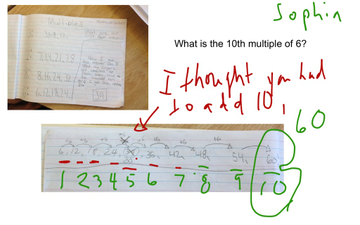
Students worked in pairs and used Apps such as "Educreations" to take pictures, audio record and write their mathematical thinking for sharing with peers.
zoom_out_map

Technology- Whole class sharing

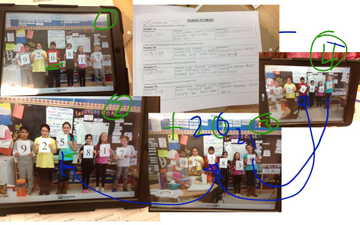
Students shared their thinking with the class and peers were able to make comments and ask questions for greater understanding. Students were accountable for their learning and their peers by answering questions effectively and ensuring they were able to clarify any concerns. They were also able to share their love of certain math concepts!
zoom_out_map

Technology - Assessment

The teacher was also able to access their Educreations through email for assessment 'as' and 'of' purposes and for sharing with colleagues for reflective discussions on students needs and next steps.
Math Markus Sophia Multiple | Educreations

Math Markus Sophia Multiple | Educreations

Educreations is a community where anyone can teach what they know and learn what they don't. Our software turns any iPad or web browser into a recordable, interactive whiteboard, making it easy for teachers and experts to create engaging video lessons and share them on the web. Students can replay these lessons any time, any place, on any connected device. We're on a mission to dramatically improve student achievement by extending the reach of great teaching.

launch educreations.com

Grade 3 Grade 3

Sharing our Mathematical Thinking

The inquiry delved into accountable talk at the consolidation stage in Three-Part Math lesson planning where Part 1: Minds On, Part 2: Action Part 3: Consolidation. Too often we don't get to or rush through the consolidation stage but this is found to be the most crucial component of the three-part lesson for students to solidify their thinking, ask questions for clarification and engage in dialogue.

Talk Moves


When students talk about mathematics in a purposeful way it reveals their understanding of concepts and the thinking behind their reasoning. Research shows that “asking students to talk (or use Talk Moves) about mathematical concepts, procedures, and problem solving helps students understand more deeply and with greater clarity” according to Chapin, O`Connor and Anderson.


Talk Moves are described as six key moves to help students engage in meaningful math talk;

1) Say More, ask students to elaborate

2) Revoicing, teacher repeats part or all of the students explanation and asks for verification of interpretation

3) Repetition, teacher ask students to restate someone else`s reasoning

4) Press for reasoning, teacher asks student to explain how or why they came to their solution

5) Do you Agree or Disagree, teacher asks students and also asks to justify why

6) Wait time, teacher allows quiet thinking time to develop responses

Resources used for making thinking Visible Resources used for making thinking Visible

Accountable Talk - A Haiku Deck by Sally Khan

Accountable Talk - A Haiku Deck by Sally Khan

Education math

launch haikudeck.com

LNS: Capacity Building Series

zoom_out_map
Collaborative Teacher Inquiry
zoom_out_map
Communication in Mathematics Classrooms
zoom_out_map
Grand Conversations
zoom_out_map

Co-Construct: How To Solve Problems

Students solved a math problem and then after we discussed what were the various steps they used to solve that problem and recorded the collection of ideas on this chart.
zoom_out_map

Working in Ability Pairs

Students used the App "Remarks" capture their thinking and shared with the class with this visual prompt and oral sharing.
zoom_out_map

Consolidate

Students engaged in a variety of consolidation activities such as gallery walks, math congress and bansho to share their learning and clarify their understanding of the math learned that day.

Accountable for your learning too!

In this video the grade three student finds herself as the 'teacher'. Another student offered up the strategy to divide in this math problem and a few students commented that "it doesn't make sense the divide" the student that offered the strategy tried to explain his thinking and got lost in his words. It was a good sign as he was starting to think more deeply about it. The student in the video offered to try to clarify for him. She realized the need to help her peer and had taken ownership of the collective learning of the class. She explains to the student the best she can how using division as a strategy for this task would not yield the desired answer. She uses language that makes sense to her and feels safe, and confident to clarify the thinking. The teacher acknowledged at the end that this was a powerful lesson and thanked the student for being brave for sharing his strategy so we can all learn from it and to the other student for making the thinking visible for all learners.
https://www.youtube.com/watch?v=UbTsDA3hixw&feature=youtu.be

Key Learnings

Establishing a Growth Mindset was ubiquitous for student confidence, learning and achievement.

Student engagement increased and the amount of "on-task or "accountable talk" increased markedly.


Integration of educational theory, technology, and current resources into teaching, allowed educators to be more reflective practitioners for educating the 21st century learner.


The over lying goals according to Michael Fullan of the 6 C's of the 21st Century learner is to better equip students with the values, structures, and tools to communicate, collaborate and be creative which these inquiries aimed to achieve.


The most critical learning for the Castlebridge PS educators are as follows:


A culture of mutual respect and understanding was clearly established when students took on a growth mindset and gained greater trust in themselves and in their peers so that knew "we are all here to learn, to learn from each other and to be accountable for everyone's learning".


All these inquiries are ongoing and continue to grow and reveal more about the student experience.

if you hear “I can`t do it” Add “Yet” -Growth Mindset if you hear “I can`t do it” Add “Yet” -Growth Mindset

zoom_out_map

Salima Khan, M.ED, OCT

Student Work Study Teacher

Peel District School Board

Email: salima.khan@peelsb.com
Website: salimashelizathesociallearner.wordpress.com
Twitter: @teachologist101

Loading indicator

close

Created with

Communicate quickly and effectively with interactive newsletters.

Smore empowers educators to connect with their community, streamline school communications,
and increase engagement.

Create a newsletter